

Key takeaway
Vibe coding can dramatically shorten the path from an idea to a working prototype, but it does not remove responsibility for security, privacy, testing or maintenance.
For Australian businesses, the safest approach is AI-accelerated development with clear human ownership—not blind deployment.
Use vibe coding to explore and validate ideas, then apply professional engineering controls before real customers, sensitive data or critical business processes are involved.
A few years ago, turning an idea into working software usually required coding skills, a development team or a significant project budget. In 2026, a business owner can describe an application in everyday language and watch an AI agent create screens, databases, integrations and working features.
That experience feels transformative. It can also create false confidence.
A polished interface is not proof that an application is secure, scalable or ready to handle customer information. Hidden behind the attractive screen may be weak authentication, exposed secrets, unreliable business rules, poor accessibility or code nobody in the organisation understands.
This guide explains vibe coding, where it creates genuine value and where human engineering remains essential. It also presents a practical framework Australian organisations can use to move from an exciting AI-generated prototype to dependable software.
What Is Vibe Coding?
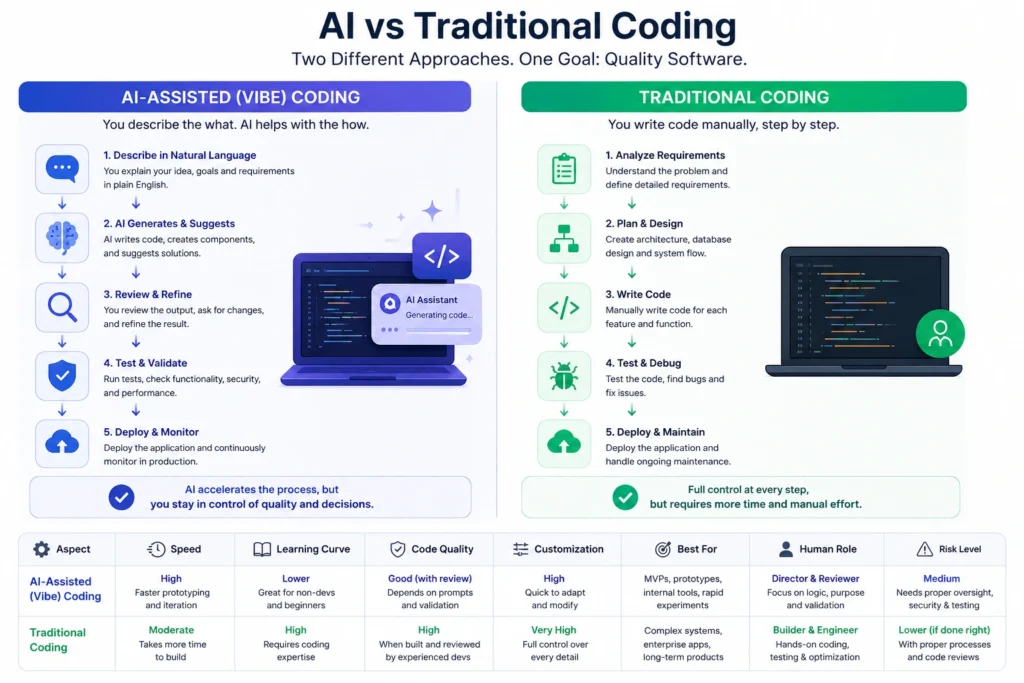
Vibe coding is a software-development approach in which a person describes the desired result in natural language and an AI system generates, changes and troubleshoots the code. Instead of manually writing every instruction, the user directs the outcome, reviews the behaviour and repeatedly asks the AI to improve it.
AI researcher Andrej Karpathy introduced the term in February 2025 when describing a highly relaxed approach in which the user largely accepts what an AI coding assistant produces. The original idea involved “forgetting” that the underlying code existed and concentrating on whether the application appeared to work. (Merriam-Webster)
The phrase is now used more broadly. It can describe anything from a non-programmer creating a weekend project to an experienced engineer directing several AI agents while reviewing every change.
That broad use creates confusion. Two people may both say they are vibe coding even though one is blindly accepting generated code and the other is following a disciplined software-development lifecycle.
A useful distinction is:
Pure vibe coding
The user describes the desired result, runs the output and keeps prompting until it appears correct. The source code receives little or no systematic review.
This approach may be reasonable for:
- Disposable experiments
- Personal utilities
- Mock-ups
- Design exploration
- Low-risk demonstrations
- Learning exercises with no real data
AI-assisted engineering
The AI writes or modifies substantial amounts of code, but people remain accountable for architecture, security, testing, data handling, code review and production approval.
This approach is more appropriate for:
- Customer-facing products
- Internal business systems
- SaaS platforms
- Paid applications
- Integrations
- Long-lived software
- Applications using personal or sensitive information
The difference is not whether AI writes the code. The difference is whether a competent person understands, verifies and accepts responsibility for the result.
Why Does Vibe Coding Matter in 2026?
Vibe coding matters because AI agents can now work across multiple files, use development tools, run tests and perform multi-step tasks. This reduces the effort required to create early software, but it also moves the human role from typing code towards defining requirements, supplying context, reviewing decisions and verifying outputs.
AI-assisted development is no longer a niche experiment. Google’s 2025 DORA research surveyed nearly 5,000 technology professionals and reported that 90% used AI at work. More than 80% believed it had improved their productivity, yet 30% reported little or no trust in AI-generated code. (blog.google)
That combination—high use and limited trust—captures the state of vibe coding in 2026.
Modern agents can inspect repositories, edit files, use terminals, execute tests and prepare changes for review. GitHub describes coding agents that can research a repository, plan work, modify a branch and create a pull request. Gemini Code Assist can use files, tools and project context to complete multi-step tasks, while Codex and Claude Code operate across editors and terminal-based workflows. (Google for Developers)
However, better generation does not mean every task becomes faster.
A randomised study of 16 experienced open-source developers working on mature projects found that the early-2025 AI tools tested increased completion time by 19%, even though participants believed they were working faster. The result should not be generalised to every modern tool or project, but it demonstrates that review, correction and integration can outweigh generation speed in complex codebases. (arXiv)
The practical lesson is simple: AI productivity depends on the task, the codebase, the user’s expertise and the quality of the surrounding development process.
How Does Vibe Coding Work?
Vibe coding usually follows a conversational loop: describe the problem, ask the AI to propose a solution, generate a small version, run it, inspect the result and provide corrective instructions. Responsible teams add requirements, version control, automated tests, security checks and human approval before deployment.
A basic workflow looks like this:
1. Define the outcome
Begin with the problem rather than a list of technologies.
Weak objective:
Build me an AI business app.
Stronger objective:
Create an internal web application that allows five sales employees to record enquiries, assign follow-up dates and view overdue opportunities.
The second version gives the agent a user group, purpose and measurable behaviour.
2. Describe the users and workflow
Explain:
- Who will use the application
- What they need to accomplish
- What information enters the system
- What decisions the software makes
- What happens when something goes wrong
- Who can view or change each type of information
3. Establish constraints
Define the limits before generating code:
- Approved technology stack
- Hosting environment
- Data location
- Authentication method
- Accessibility requirements
- Browser and device support
- Integrations
- Performance expectations
- Information that must never enter the AI tool
4. Ask for a plan before implementation
A capable agent should first explain:
- Proposed architecture
- Data model
- Main components
- Security assumptions
- External services
- Test approach
- Known uncertainties
Reviewing a plan is cheaper than correcting hundreds of generated files.
5. Build a small vertical slice
Generate one complete user journey rather than the whole platform.
For example:
- A user signs in.
- They create an enquiry.
- The record is validated.
- It is stored.
- The user can retrieve it.
- The action appears in an audit log.
This reveals architectural problems before they spread.
6. Test and review every change
Use automated checks and human inspection. Ask whether the output works not only in the ideal scenario but also with invalid input, missing permissions, failed integrations and unexpected user behaviour.
7. Deploy through a controlled process
Production deployment should include approvals, backups, monitoring, incident response and rollback capability. An agent should not be given unrestricted authority over sensitive infrastructure simply because it generated a successful preview.
What Is Vibe Coding Best Used For?
Vibe coding is best for projects where rapid learning is more valuable than immediate perfection. It performs particularly well for prototypes, internal utilities, workflow experiments, user-interface concepts, code scaffolding and narrow applications that can be tested without exposing sensitive information or critical operations.
Prototypes and proofs of concept
A prototype helps stakeholders experience an idea rather than debate a document. Teams can test navigation, workflow and customer interest before committing to a full build.
Internal productivity tools
Examples include:
- Content approval trackers
- Simple quotation calculators
- Meeting-note organisers
- Inventory lookup interfaces
- Reporting dashboards
- Data-cleaning utilities
- Form-to-document workflows
These projects still require security controls, but their limited scope can make them easier to validate.
Marketing experiments
A marketing team might create:
- Interactive calculators
- Campaign landing pages
- Lead-qualification tools
- Product selectors
- Assessment forms
- Personalised content demonstrations
These initiatives connect naturally with a broader digital marketing strategy, provided tracking, consent, performance and data collection are handled correctly.
Interface exploration
Vibe coding can rapidly turn written requirements, sketches or screenshots into interactive interfaces. Designers and developers can then refine the strongest direction.
Boilerplate and repetitive implementation
Experienced developers can delegate routine setup, tests, documentation and predictable components while concentrating on architecture and unusual business rules.
Learning and technical discovery
A founder can use an AI-built model to understand what an idea requires before speaking with a software team. The prototype becomes a conversation aid rather than the final product.
When Should You Not Rely on Vibe Coding Alone?
Do not rely on unreviewed AI-generated code for systems that control money, health, identity, safety, legal rights, regulated decisions or sensitive personal information. These projects require documented requirements, qualified review, security testing, governance and accountable production ownership.
Higher-risk examples include:
- Payment and financial systems
- Health or disability-service platforms
- Identity verification
- Authentication and authorisation services
- Employment or credit decisions
- Safety-critical equipment
- Government services
- Legal or compliance systems
- Applications for children
- Platforms containing sensitive personal information
- Business-critical integrations
- High-volume customer platforms
- Systems requiring guaranteed availability
Vibe coding may still assist experienced teams in these areas. The risk comes from treating generated output as trustworthy merely because it runs.
Vibe Coding vs Traditional Coding vs Low-Code
Vibe coding uses natural-language instructions to generate software dynamically. Traditional development gives engineers direct control over implementation, while low-code platforms provide predefined visual components and rules. Each method can be effective, but they offer different levels of speed, flexibility, transparency and long-term control.
| Factor | Vibe coding | Traditional development | Low-code or no-code |
| Primary interface | Natural-language prompts | Programming languages and engineering tools | Visual components and configuration |
| Early speed | Very fast for suitable prototypes | Slower initial setup | Fast within platform limits |
| Flexibility | Potentially high but inconsistent | Highest when properly engineered | Limited by platform capabilities |
| Required expertise | Low to begin; higher to verify | Professional technical expertise | Platform knowledge |
| Code visibility | Varies by tool | Full | Often limited |
| Maintainability | Depends heavily on review | Can be designed deliberately | Depends on vendor and configuration |
| Security | Must be independently verified | Can follow a controlled secure lifecycle | Shared with platform provider |
| Vendor dependence | Moderate to high | Can be minimised | Usually high |
| Best fit | Exploration and accelerated building | Complex, critical or long-lived systems | Standard workflows and business apps |
| Main risk | False confidence in generated output | Cost, time and overengineering | Platform limits and lock-in |
The methods can also be combined. A team may use vibe coding for discovery, traditional engineering for the production core and a low-code platform for an administrative workflow.
What Are the Main Benefits of Vibe Coding?
The main benefits are faster experimentation, lower barriers to software creation, shorter feedback loops and better communication between technical and non-technical participants. These advantages are strongest when teams use the saved time to learn and validate—not simply to release more unreviewed code.
Faster movement from idea to evidence
A working prototype can expose weaknesses that remain hidden in written requirements.
Greater access to software creation
Founders, marketers, designers and operational specialists can test ideas without first mastering a programming language.
Improved communication
An interactive model gives stakeholders something concrete to assess. They can identify missing fields, confusing steps or incorrect assumptions earlier.
More iterations within the same discovery period
Teams can compare several approaches before selecting one for further investment.
Support for experienced developers
AI agents can perform repetitive implementation, generate test cases, explain unfamiliar code and propose refactoring options.
Smaller experiments
A business can test whether a problem is worth solving before funding a complete platform. This aligns with a controlled digital-transformation framework based on measurable business outcomes rather than fashionable technology.
What Are the Risks of Vibe Coding?
Vibe coding can create security vulnerabilities, weak business logic, poor maintainability, privacy exposure and dependency on tools or code the organisation does not understand. The most serious risk is not that AI makes mistakes; it is that attractive, functioning output encourages people to skip normal verification.
Security vulnerabilities
A 2026 study of deployed vibe-coded applications identified recurring issues including placeholder logic, unfiltered input and exposed secrets. The researchers found that stronger models and improved prompting reduced some problems but did not eliminate the underlying risk. (arXiv)
Common areas requiring review include:
- Access control
- Authentication
- Session management
- Input validation
- Database permissions
- API keys
- File uploads
- Dependency security
- Error messages
- Logging
- Encryption
- Rate limiting
Comprehension debt
Technical debt exists in the software. Comprehension debt exists in the people responsible for it.
A team may generate changes faster than it can understand them. When the application later fails, nobody knows which assumptions shaped the design or where a feature should be modified.
Research involving 162 vibe coders found that users across experience levels recognised many of the same risks, but their ability to verify and debug outputs differed. Non-developers gained access to software creation without gaining the same capacity to evaluate what had been created. (arXiv)
Incorrect business rules
An application can run successfully while calculating the wrong price, assigning the wrong permission or omitting an important exception.
Visual testing alone will not reveal every logic error.
Privacy exposure
Users may paste customer records, employee details, proprietary code or confidential documents into an AI service without checking how that information is processed or retained.
Unreliable dependencies
An agent may select poorly maintained packages, incompatible versions or unnecessary services. Every dependency introduces maintenance and supply-chain considerations.
Cost drift
Generating the first version may be inexpensive. Costs can emerge later through:
- Rework
- Security remediation
- Cloud usage
- Database services
- Model calls
- Third-party APIs
- Monitoring
- Support
- Migration
- Vendor lock-in
Weak accessibility and user experience
A visually polished interface may still be difficult to navigate by keyboard, screen reader or mobile device. Accessibility needs explicit requirements and testing.
Lack of accountability
When something fails, “the AI wrote it” is not an acceptable operational response. A person or organisation must own the requirements, release decision and consequences.
What Australian Rules Should Businesses Consider?
Australian businesses should treat vibe coding as part of their existing privacy, cybersecurity, consumer, employment and industry obligations. AI does not create an exemption from those requirements. The level of governance should increase with the sensitivity of the data and the possible impact on customers, employees or the public.
This section provides general information, not legal advice.
Privacy Act and Australian Privacy Principles
The OAIC states that the Privacy Act and Australian Privacy Principles apply to uses of AI involving personal information where the organisation is covered by the Act. Its guidance recommends considering what information enters an AI system, how it is used, where it is processed and what security measures protect it. (OAIC)
APP 11 requires covered entities holding personal information to take reasonable steps to protect it from misuse, interference, loss, unauthorised access, modification and disclosure. (OAIC)
Before using customer or employee data with an AI coding product, assess:
- Whether the information is necessary
- Whether it can be anonymised or replaced with synthetic data
- Where it will be processed
- Whether it may cross national borders
- Whether the provider retains prompts or files
- Who can access generated logs
- Whether the data is used for model improvement
- How it can be deleted
- Whether contractual protections are adequate
Voluntary AI Safety Standard
Australia’s National AI Centre published ten voluntary guardrails covering accountability, risk management, data governance, testing, human oversight, transparency and stakeholder considerations. The standard is voluntary, but its structure offers a useful governance reference for organisations adopting AI. (industry.gov.au)
For vibe coding, the most relevant principles include:
- Assigning an accountable owner
- Assessing risk before deployment
- Protecting systems and data
- Testing performance
- Monitoring after release
- Maintaining meaningful human oversight
- Keeping records of important decisions
- Evaluating impacts on affected users
Secure-by-design development
The Australian Signals Directorate describes Secure by Design as integrating security throughout the development of a product or service. Its software-development guidance recommends secure programming, threat modelling, testing and mitigation of common security risks. (cyber.gov.au)
That principle applies regardless of whether code is written by a person or generated by an AI agent.
How Can Businesses Use Vibe Coding Safely?
Businesses can use vibe coding more safely by limiting each project’s scope, protecting data, specifying requirements, keeping every change in version control, testing automatically, reviewing security and assigning a qualified owner. The goal is not to eliminate experimentation but to prevent an experiment from quietly becoming an unmanaged production system.
Use the following VIBE-SAFE framework.
V — Validate the problem and risk
Document:
- The business problem
- Intended users
- Expected benefit
- Data involved
- Potential harm
- Regulatory constraints
- Criteria for success
Do not begin with a tool subscription.
I — Isolate data and permissions
Use synthetic or de-identified information during development.
Place the agent in a restricted environment. Do not provide broad access to:
- Production databases
- Customer records
- Payment systems
- Administrator credentials
- Cloud accounts
- Internal secrets
- Unrelated repositories
Australian cyber guidance on agentic AI recommends avoiding broad or unrestricted access, particularly where sensitive data or critical systems are involved. (cyber.gov.au)
B — Build small and reversible
Create one narrow workflow at a time. Use branches, checkpoints and backups so changes can be reviewed or reversed.
E — Evaluate behaviour and code
Check both:
- What users see
- How the underlying system achieves it
Review data flows, permissions, error handling, dependencies and hidden assumptions.
S — Secure by design
Add security requirements before generation rather than asking the AI to “make it secure” at the end.
Use:
- Threat modelling
- Dependency scanning
- Static analysis
- Secret detection
- Access-control tests
- Input validation
- Secure configuration
- Penetration testing where appropriate
A — Assign accountable ownership
Name the person responsible for:
- Requirements
- Architecture
- Privacy
- Security
- Deployment
- Support
- Incident response
- Final approval
F — Fortify with testing and review
Include:
- Unit tests
- Integration tests
- Functional tests
- Permission tests
- Performance tests
- Accessibility checks
- Security testing
- User acceptance testing
Independent quality assurance and testing is particularly valuable when the original builder cannot confidently explain the generated code.
E — Evolve through monitoring
After release, monitor:
- Errors
- Availability
- Performance
- Security events
- Unexpected model costs
- User behaviour
- Failed transactions
- Permission anomalies
- Customer complaints
Every production application also needs an update, backup and rollback process.
What Does a Good Vibe-Coding Prompt Look Like?
A good vibe-coding prompt describes the user, desired outcome, workflow, data, constraints, exceptions and acceptance criteria. It should ask the agent to explain its plan and assumptions before writing code, then request implementation in small, testable stages rather than one uncontrolled generation.
Weak prompt
Build a modern CRM for my business. Make it secure and easy to use.
Stronger prompt
Create a plan for a browser-based enquiry tracker for an Australian professional-services business.
Users: five sales employees and one administrator.
Core workflow: employees create enquiries, assign follow-up dates, add notes and mark outcomes. Administrators can manage users and export monthly summaries.
Data: names, business email addresses, phone numbers, enquiry source and notes. Do not use real customer data during development.
Security: require authenticated access, role-based permissions, server-side validation, protected secrets and audit logging.
Technical constraints: propose a maintainable architecture using widely supported technologies. Keep external dependencies to a minimum.
Quality requirements: responsive interface, keyboard navigation, automated tests for permissions and validation, and clear error states.
Before writing code, provide the proposed architecture, data model, security assumptions, external services, test strategy and unresolved questions. Wait for approval before implementation.
This prompt does not guarantee good software. It creates a better starting point for review.
What Is a Realistic Vibe-Coding Use Case?
A realistic use case is a narrowly scoped internal tool that replaces a manual process without immediately connecting to critical systems. The business can validate the workflow using synthetic data, test it with a small user group and involve professional engineers before adding sensitive information or external customers.
Consider an illustrative Australian trade-services company.
Employees currently prepare basic quote requests through email and spreadsheets. Management wants a simple interface that collects job type, suburb, preferred date and required equipment.
A controlled process could be:
- Map the existing workflow.
- Define required fields and pricing rules.
- Generate a prototype using fictional customers.
- Test it with two employees.
- Identify exceptions and missing information.
- Have an engineer review the architecture and code.
- Add authentication and role-based access.
- Test calculations and permissions.
- Connect approved business systems through documented APIs.
- Deploy to a restricted group.
- Monitor errors and user adoption.
- Expand only after the evidence supports it.
The prototype helps the business learn quickly. Professional engineering makes the validated idea dependable.
For more complex products, Cognify Digital’s guide to architecting an AI-first SaaS application explains the wider platform considerations.
How Much Does Vibe Coding Cost?
There is no standard price for vibe coding. A simple experiment may require only a tool subscription and a small amount of hosting, while a production application can still require substantial spending on architecture, integrations, security, testing, infrastructure, compliance, maintenance and professional review.
Do not compare options using generation cost alone.
A realistic cost model includes:
- Discovery and requirements
- AI tool usage
- Design
- Development
- Code review
- Security assessment
- Privacy or legal advice
- Testing
- Cloud hosting
- Databases
- AI model calls
- Third-party APIs
- Monitoring
- Backups
- Support
- Future changes
- Migration or exit costs
The least expensive way to produce a demo is not necessarily the least expensive way to operate a reliable product.
Before committing to a platform, ask:
- Can the source code be exported?
- Who owns the generated assets?
- Can another developer maintain it?
- What services are required after export?
- How is usage priced?
- Can data be moved?
- What happens if the provider closes or changes terms?
- Are deployment and database choices portable?
Who Should Use Vibe Coding?
Vibe coding is useful for founders, product managers, designers, marketers, operational specialists and developers who need to explore or implement ideas quickly. The level of independent review should depend on the user’s technical ability, the application’s complexity and the consequences of failure.
Non-technical founders
Use it to clarify an idea, test a workflow and communicate with potential users or developers.
Do not assume the first working version is a finished product.
Marketing teams
Use it for calculators, interactive content and campaign experiments while controlling analytics, consent and collected data.
Product managers and designers
Use it to create prototypes and compare user journeys before full implementation.
Operations teams
Use it to explore small internal tools, but involve IT and security before connecting operational data or business systems.
Professional developers
Use agents for implementation, testing, explanation and repetitive work while retaining architectural and review responsibility.
Established businesses
Create an approved AI-development policy, controlled environments and a clear production gate. Technology consulting can help determine which ideas suit rapid AI-assisted development and which require a conventional delivery programme.
Will Vibe Coding Replace Software Developers?
Vibe coding is more likely to change software-development work than eliminate it. AI can generate implementation rapidly, but organisations still need people to define the right problem, design systems, evaluate trade-offs, protect data, verify behaviour, manage incidents and maintain software over time.
The relative value of different skills is shifting.
Developers may spend less time typing routine syntax and more time on:
- Requirements
- Architecture
- Context design
- Agent coordination
- Code review
- Testing
- Security
- Integration
- Performance
- Observability
- Product judgement
- Communication
Writing skill also matters. A 2026 study of 100 tertiary students found that both computer-science achievement and written-communication proficiency predicted vibe-coding performance. Technical knowledge remained significant even after the researchers controlled for broader cognitive skills. (arXiv)
The future is therefore unlikely to be “prompts instead of expertise”. It is more plausibly expertise expressed through prompts, specifications, tools and verification.
What Is the Future of Vibe Coding in Australia?
Vibe coding is likely to become a normal part of digital work, even if the fashionable term eventually changes. Australian organisations will gain the most value when they combine rapid AI-assisted creation with privacy, cybersecurity, quality assurance, accountable ownership and disciplined pathways from prototype to production.
This is an inference based on current tool development, adoption research and Australian AI guidance rather than a guaranteed forecast. (blog.google)
The likely direction includes:
- More capable coding agents
- Better project context and memory
- Increased use of multiple specialised agents
- Automated testing and review
- Tighter integration with design and business systems
- Stronger enterprise controls
- Greater demand for AI-development governance
- More software created by small teams
- Higher expectations for professional verification
- Growing attention to maintainability and comprehension
The organisations that benefit will not necessarily be those that generate the most code. They will be those that turn valuable ideas into reliable outcomes without losing control of their data, systems or responsibilities.
Vibe-Coding Readiness Checklist
Before beginning:
- The business problem is clearly defined.
- Intended users are identified.
- Success can be measured.
- The project’s risk level is documented.
- Data has been classified.
- Sensitive information will not be used during uncontrolled experimentation.
- Tool terms and data practices have been reviewed.
- An accountable owner has been assigned.
- An approved development environment is available.
- Source code will be retained in version control.
- The project can be built in small, reversible stages.
- Test requirements are documented.
- Security review is planned.
- A production approval gate exists.
- Monitoring, support and rollback responsibilities are defined.
Final Perspective
Vibe coding has changed who can create software and how quickly an idea can become interactive. That is a meaningful shift.
But a prototype that looks complete may conceal unfinished engineering. Speed at the beginning does not remove the need for security, testing, accessibility, privacy, architecture and long-term ownership.
The most effective approach is neither to reject AI-generated code nor trust it blindly. Use AI to reduce the cost of learning. Use human expertise to decide what deserves to survive beyond the experiment.
Cognify Digital helps Australian organisations assess ideas, build controlled prototypes and develop scalable digital products. Explore its software and AI development services or discuss a project through the Cognify Digital contact page.

0 Comments