
Key Takeaways
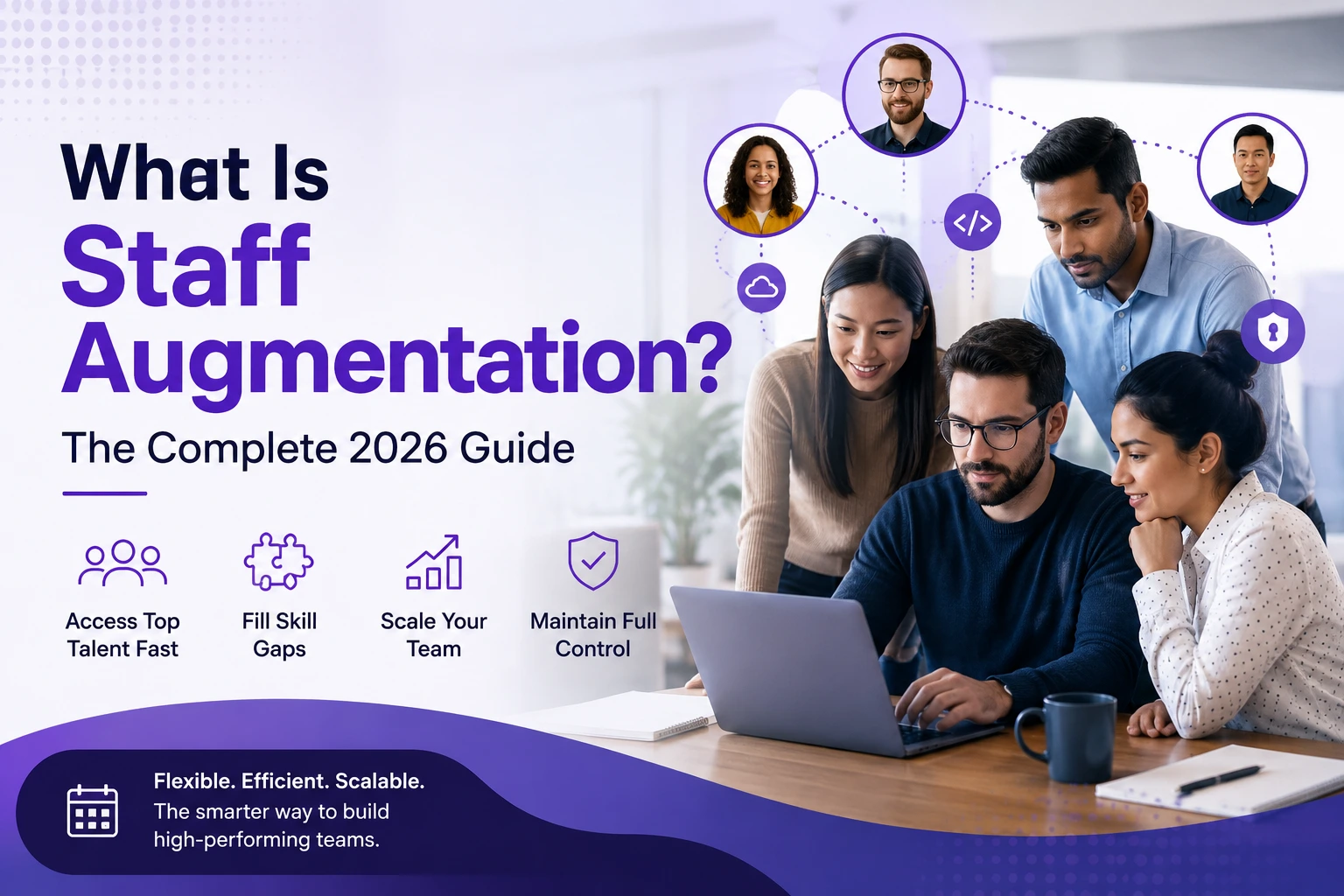
- Staff augmentation is a hiring model where a business adds external specialists to its existing in-house team, on a temporary or contract basis, without those workers becoming full-time employees.
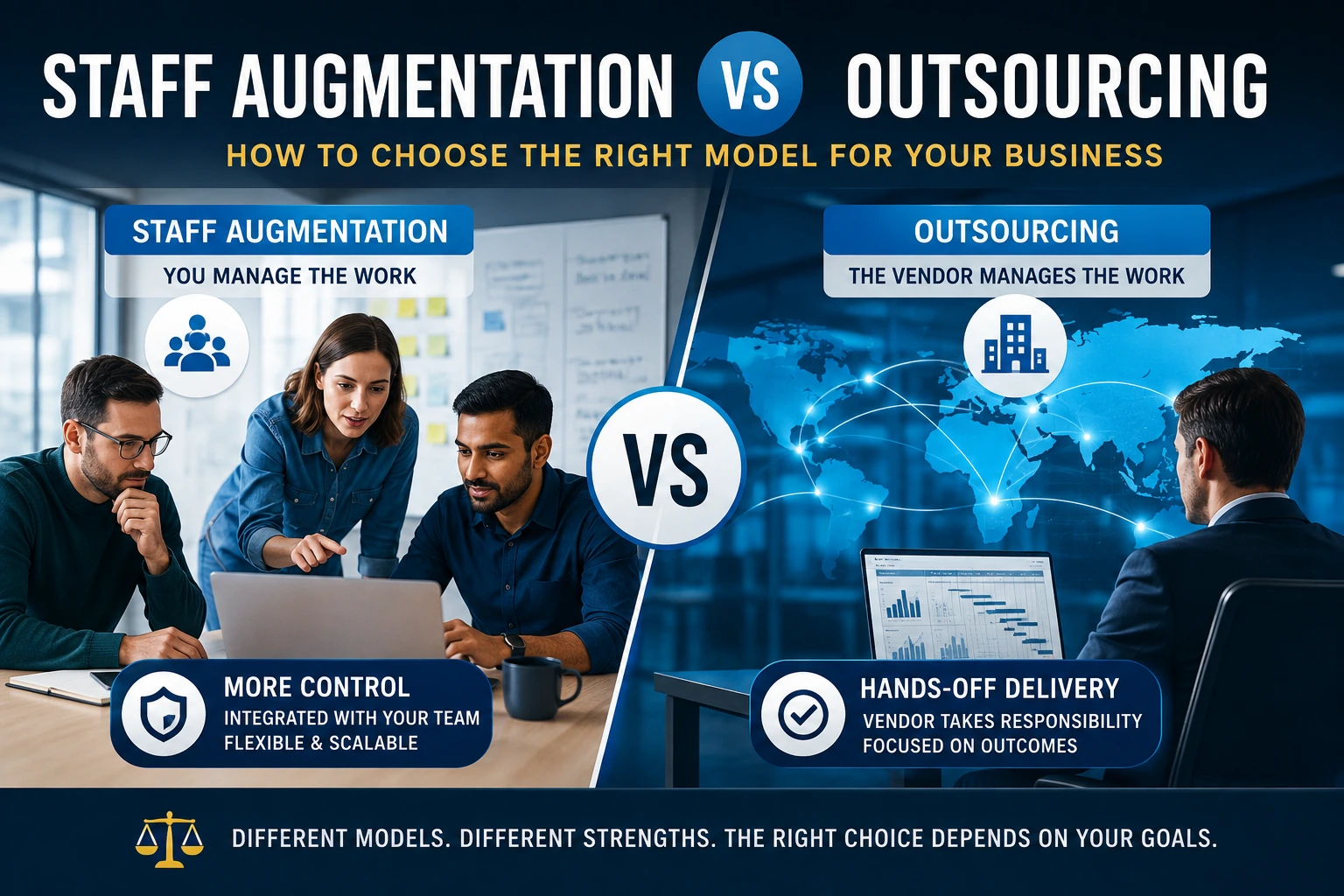
- It differs from outsourcing because the client keeps day-to-day management and control; the augmented staff work inside the client's own processes and tools.
- The Tech Council of Australia's 2021 goal of one million tech workers by 2025 fell just short — the workforce reached roughly 977,000 by November 2025 — and shortages persist in specific specialisations even though general software engineering came off the national shortage list that year.
- It suits short-term skill gaps, project spikes, and specialist roles (QA, DevOps, AI/ML); it's a poor fit for long-term strategic ownership or when a business wants a vendor to own outcomes end-to-end.
- Costs are usually charged as an hourly or day rate per contractor, sitting between the cost of a full outsourced project and a permanent local hire.
Nearly a third of assessed occupations in Australia — 293 of 1,022 — were officially in shortage in the 2025 Occupation Shortage List published by Jobs and Skills Australia. General software engineering roles actually came off that list for the first time in 2025, but specialist gaps in areas like cyber security, software testing and cloud/DevOps persist. When a software team hits a wall — a release deadline looms, a QA specialist quits, or a project suddenly needs someone who knows Kubernetes cold — hiring a permanent employee can take months Australia doesn't have to spare. Staff augmentation exists to close that gap fast. This guide explains exactly what staff augmentation is, how it works, what it costs, and when it's the right call for a software project.
What Is Staff Augmentation?
Staff augmentation is a staffing model in which a company temporarily adds external specialists — developers, testers, DevOps engineers, designers — to its existing in-house team, sourced through a staffing partner or agency. The client directs the work, sets priorities and manages output day to day; the augmented staff simply plug the skills or capacity gap.
Unlike a full project handover, the augmented professional becomes, functionally, a temporary member of the client's own team. They join daily stand-ups, use the client's tools, Git repositories and communication channels, and report to the client's technical lead rather than to an external project manager. The staffing partner typically handles recruitment, payroll, contracts and compliance for that worker, while the client retains full technical and operational control.
The model applies across software development, QA, cloud/DevOps, UI/UX, data and AI engineering, and is sometimes called IT staff augmentation, team augmentation, or technology staff augmentation — the terms are used loosely, though IT staff augmentation technically covers a broader set of roles (network admins, security analysts, systems analysts) beyond pure software developers.
How Does Staff Augmentation Work?
A business identifies a skill or capacity gap, defines the role and required experience, and engages a staffing partner. The partner shortlists pre-vetted candidates, the client interviews and selects who they want, and the chosen specialist starts working inside the client's team — usually within one to a few weeks, on an hourly or daily contract rate.
Typical process, step by step
- Scope the gap. Define the exact skill, seniority level, and expected duration — e.g. "one senior Playwright test automation engineer, three months, full-time."
- Engage a partner. A staffing or software delivery partner sources candidates from its own vetted talent pool or network.
- Screen and select. The client interviews shortlisted candidates and makes the final hiring decision — this is the key difference from a black-box outsourced project.
- Onboard. The specialist is granted access to the client's tools, codebase, and communication channels and is briefed on internal standards.
- Manage directly. The client's own technical lead assigns tasks, reviews work and manages performance, exactly as they would an internal hire.
- Scale or exit. The engagement flexes up or down with demand; if a contractor isn't the right fit, the client requests a replacement rather than running a termination process.
Staff Augmentation vs Outsourcing vs Dedicated Teams vs Managed Services
Staff augmentation adds individuals under the client's own management; outsourcing hands an entire project or outcome to a vendor's management; a dedicated team is a vendor-assembled team still directed largely by the client; managed services means an external provider owns ongoing operation and support of a live system.
| Model | Who manages the work | Best for | Control level |
| Staff augmentation | Client | Filling specific skill gaps, short-term capacity spikes | High |
| Outsourcing (project-based) | Vendor | Well-defined projects with a fixed scope and deliverable | Low–medium |
| Dedicated team | Shared (client sets priorities; vendor manages delivery) | Long-term product builds needing a stable, ring-fenced team | Medium–high |
| Managed services | Vendor | Ongoing support, maintenance and optimisation of a live product | Low |
None of these models is objectively "better" — the right choice depends on how much control a business wants to retain and how well-defined the work is. Businesses that already have strong internal technical leadership tend to get the most value from staff augmentation, because they can direct the augmented specialist effectively from day one.
Types of Staff Augmentation
By location
- Onshore — talent hired within the same country, e.g. Australia-based contractors for an Australian business. Highest cost, closest time-zone and cultural alignment.
- Nearshore — talent in a nearby or similar time-zone region, offering a balance of cost and overlap in working hours.
- Offshore — talent in a distant, typically lower-cost region; requires stronger asynchronous processes and documentation.
By commitment
- Short-term augmentation — weeks to a few months, usually to cover a spike, a leave gap, or a specific deliverable.
- Long-term augmentation — six months or longer, functioning almost like an extended in-house hire, common for ongoing product development.
What Are the Benefits of Staff Augmentation?
Staff augmentation gives businesses faster access to specialist skills, more flexible scaling than permanent hiring, lower overhead than building an in-house team from scratch, and full control over how the work is directed — while avoiding the multi-month lead time and long-term commitment of a permanent hire.
- Speed. A vetted specialist can typically start within days to a few weeks, versus the 30–70 days it often takes to hire and onboard a senior developer permanently.
- Access to scarce skills. Specialist roles in AI/ML, cybersecurity and cloud remain in persistent shortage in Australia; augmentation opens a wider talent pool than local recruitment alone.
- Flexibility. Scale the team up for a release and back down once the crunch passes, without redundancy processes.
- Retained control. Unlike outsourcing, the client's own leads still make technical decisions and manage priorities.
- Lower overhead. No payroll tax, superannuation, recruitment fees or long-term entitlements to manage for augmented staff — that sits with the staffing partner.
- Reduced hiring risk. If a contractor isn't a fit, the engagement ends or the person is swapped, without the cost and complexity of a poor permanent hire.
Why Staff Augmentation Matters for Australian Businesses in 2026
Australia's technology workforce is large and growing but hasn't fully closed its skills gap: the Tech Council of Australia's 2021 target of one million tech workers by 2025 landed just short, at roughly 977,000, and while general software engineering came off the national shortage list in 2025, specific specialisations — cyber security, software testing, cloud and AI — remain persistently hard to fill.
Two datasets tell a more precise story than the headline "tech skills shortage" framing suggests. In 2021, the Tech Council of Australia set a goal of growing the national tech workforce to one million by 2025, estimating the country would need roughly 286,000 additional workers to get there. By November 2025, that workforce had reached approximately 977,000 — a substantial gain, but short of the original target. At the same time, Jobs and Skills Australia's 2025 Occupation Shortage List confirmed 293 of 1,022 assessed occupations nationally — about 29% — remain in shortage nationally, down from 33% in 2024. Notably, general software engineer roles came off the national shortage list entirely for the first time since JSA began tracking in 2021, even as roles like software testers and cyber security engineers stayed on it. The practical read: broad "we need a developer" gaps have eased, but specialist and senior gaps haven't.
Retention adds a second layer of risk on top of scarcity. In a Gartner survey covering IT workers globally, only 23.6% of Australia and New Zealand IT workers reported high intent to stay with their current employer — among the lowest of any region measured. As one Gartner analyst put it more recently while discussing IT workforce planning: "talent scarcity is your new normal." That combination — a persistent skills gap plus high attrition risk — is exactly the environment staff augmentation was built for: it lets a business add capacity without betting an entire project on a single permanent hire staying put.
What Are the Risks and Challenges of Staff Augmentation?
The main risks are management overhead (the client must actively direct augmented staff, unlike outsourcing), onboarding friction for short engagements, knowledge walking out the door when a contract ends, and security/access risk if offboarding isn't handled properly.
- You still have to manage it. Staff augmentation assumes the client has the technical leadership to direct contractors effectively — it isn't a hands-off model.
- Culture and process fit. Augmented staff need clear documentation and onboarding, or ramp-up time eats into the value of a short engagement.
- Knowledge continuity. Without deliberate documentation and pairing, expertise can leave when a contract ends.
- Access and security governance. Every augmented hire needs a defined offboarding process — revoked repository, cloud and system access — to avoid lingering security exposure.
- Over-reliance. Leaning on external capacity indefinitely, without building any internal capability, can leave a business permanently dependent on contractors for core skills.
When Should a Business Use Staff Augmentation?
Staff augmentation fits best when a business has strong internal technical leadership and a temporary, well-defined skill or capacity gap — such as a single missing specialism, a release-driven crunch, or covering leave — rather than when it needs a vendor to own an entire outcome.
| Good fit | Poor fit |
| A specific missing skill (e.g. one senior DevOps engineer) | No internal technical leadership to direct the work |
| A short-term spike ahead of a release or launch | A brand-new product needing full outcome ownership |
| Covering leave, parental leave or unexpected departures | Long-term strategic ownership of an entire platform |
| Testing a new technology before committing to a permanent hire | A business wanting to hand off risk entirely to a vendor |
How Much Does Staff Augmentation Cost?
Staff augmentation is typically billed as an hourly or daily rate per contractor, varying by role, seniority and sourcing location (onshore, nearshore or offshore); it generally sits between the cost of a fully outsourced fixed-scope project and a permanent local salary once on-costs are included.
Exact rates vary too widely by role, seniority, technology and region to state a single reliable figure — a market analysis by Research and Markets estimated the global IT staffing market at roughly USD 127.75 billion in 2026, growing toward USD 152.47 billion by 2031, which reflects just how much rate variation exists across markets and specialisms. Businesses evaluating cost should compare quoted rates against three things: the fully-loaded cost of a permanent local hire (salary, superannuation, payroll tax, recruitment fees, onboarding time), the opportunity cost of leaving a role unfilled, and how quickly the engagement needs to start.
How to Choose a Staff Augmentation Partner
Look for a partner with a genuinely vetted talent pool, transparent rates and replacement terms, direct access to interview candidates before they start, and — ideally — a delivery team that also builds and ships its own software, so the specialists they place understand real production standards.
- Can you interview and personally select the specialist, or are they simply assigned?
- What happens if a placement isn't working out — is a no-cost replacement offered?
- Does the partner apply any quality standard to its own delivery work (e.g. ISTQB-certified QA, defined CI/CD practice)?
- Are contracts and IP terms clear about who owns the code and data produced?
- Does the partner have a documented onboarding and offboarding process, including access revocation?
Which Roles Are Commonly Staff-Augmented?
The most commonly augmented software roles are backend and frontend developers, QA/test automation engineers, DevOps and cloud engineers, mobile developers, UI/UX designers, and increasingly AI/ML and data engineers as businesses add generative AI features to existing products.
Best Practices for Managing Augmented Staff
Getting value from staff augmentation depends on treating augmented specialists as real team members from day one: give them the same onboarding, documentation and access as an internal hire, assign a single point of accountability, and build in knowledge-sharing so expertise doesn't leave when the contract ends.
- Onboard properly, even for short engagements. A one-page brief on coding standards, branching strategy and definitely-not-to-touch systems saves days of ramp-up.
- Assign a named internal owner. Augmented staff should always know exactly who sets their priorities — ambiguity here is the single biggest cause of wasted contractor time.
- Document as you go. Treat every augmented engagement as a knowledge-transfer exercise, not just a delivery exercise, so the work is maintainable after the contractor leaves.
- Set a fixed check-in cadence. Weekly or fortnightly reviews catch scope drift and fit problems early, before they become expensive.
- Plan the offboarding before day one. Decide upfront how repository, cloud and system access will be revoked at the end of the engagement.
Common Mistakes to Avoid
The most frequent staff augmentation mistakes are skipping proper onboarding, treating a poor cultural or communication fit as unavoidable rather than requesting a replacement early, under-specifying the role before engaging a partner, and using augmentation for work that actually needs full outcome ownership.
- Under-scoping the brief. "We need a developer" produces worse candidate matches than "we need a mid-level React developer with e-commerce checkout experience for 12 weeks."
- Waiting too long to flag a poor fit. Most partners can swap a contractor quickly — delaying that decision wastes budget and momentum.
- No internal capacity to manage the hire. If nobody on the client side has time to direct an augmented specialist, the engagement underperforms regardless of the individual's skill.
- Choosing augmentation when outcome ownership is really what's needed. If a business wants a vendor accountable for a finished, working feature — not just headcount — a dedicated team or project-based model is usually the better fit.
- Ignoring time-zone overlap. Offshore augmentation without at least a few overlapping working hours can slow decision-making to a crawl.
Mini Case Study: How Skill Needs Shift Over a Product's Life
A single growing software product typically needs a different specialist at almost every stage — rostering logic at build time, mobile development for field workers, cloud and DevOps for scaling, and QA before every release — which is exactly the pattern staff augmentation is designed to flex around, rather than requiring a large permanent team sized for peak demand year-round.
Ausvanta, the NDIS compliance platform Cognify Digital engineered for Neural Networks Group, is a useful illustration of this pattern in practice. As a live product covering rostering, mobile apps for support workers, cloud hosting and audit reporting, it needs meaningfully different technical skills at different points in its roadmap — the specialism required to harden a mobile app for field use isn't the same one needed to scale cloud infrastructure ahead of a new customer segment, and neither is the same as the testing depth needed before a compliance-sensitive release. That's the practical case for staff augmentation: rather than permanently staffing for every specialism a product will ever need, a team adds the specific skill it's missing, for as long as it's needed, and scales back once that phase of work is done.
Weighing up staff augmentation against a dedicated team or a fixed-scope project? Cognify Digital's tech consulting and advisory team can help map the right engagement model to your product stage, alongside our ISTQB-certified QA and full-spectrum development services. Get a free solution outline to see how the pieces fit for your project.
Frequently Asked Questions
What is staff augmentation in simple terms?
It's hiring external specialists on a temporary or contract basis to work inside your existing team, under your own management, rather than handing a project to an outside vendor to run.
What is the difference between staff augmentation and outsourcing?
In staff augmentation, the client manages the augmented staff directly. In outsourcing, the vendor manages the work and delivers an agreed outcome, with much less day-to-day client control.
Is staff augmentation the same as a dedicated team?
They're related but not identical. A dedicated team is typically a full vendor-assembled team working on one product long-term; staff augmentation usually adds individuals into an existing internal team.
What roles can be staff-augmented?
Common roles include software developers, QA and test automation engineers, DevOps and cloud engineers, mobile developers, UI/UX designers, and AI/ML or data engineers.
How quickly can an augmented specialist start?
Typically within days to a few weeks, depending on the seniority and specificity of the skill required, compared with 30–70 days for a typical permanent senior hire.
How is staff augmentation priced?
Usually as an hourly or daily contract rate per specialist, varying by role, seniority and whether the talent is sourced onshore, nearshore or offshore.
Who manages an augmented staff member's day-to-day work?
The client's own technical lead or manager — this is the defining difference between staff augmentation and outsourcing.
What happens if an augmented specialist isn't a good fit?
Most staffing partners offer a replacement rather than requiring the client to run a formal termination process, since the specialist remains the partner's employee or contractor.
Is staff augmentation good for startups?
It can be, for filling a specific skill gap, but startups without any internal technical leadership often get more value from a dedicated team or project-based engagement, where a vendor takes on more delivery ownership.
Why is staff augmentation growing in Australia?
Roughly 29% of assessed occupations nationally remain in shortage per Jobs and Skills Australia's 2025 data, and while general software engineering has eased, specialist roles like cyber security and cloud engineering haven't — pushing businesses toward flexible external capacity for those specific gaps.
Conclusion
Staff augmentation is, at its core, a control-preserving way to close a skills or capacity gap: you keep the management, the partner supplies the person. In a labour market where nearly a third of assessed occupations are officially in shortage and IT retention is under real pressure, that flexibility is less a nice-to-have and more a practical necessity for teams that need to ship on schedule. The model isn't right for every situation — businesses without strong internal technical leadership, or those wanting to hand off an entire outcome, are usually better served by outsourcing or a dedicated team. But for a well-defined, temporary skill gap, it remains one of the fastest ways to get the right person working on the right problem.


0 Comments