
Key Takeaways
- NDIS provider software centralises participant records, rostering, NDIS-compliant invoicing and compliance evidence in one system, replacing spreadsheets and shared inboxes.
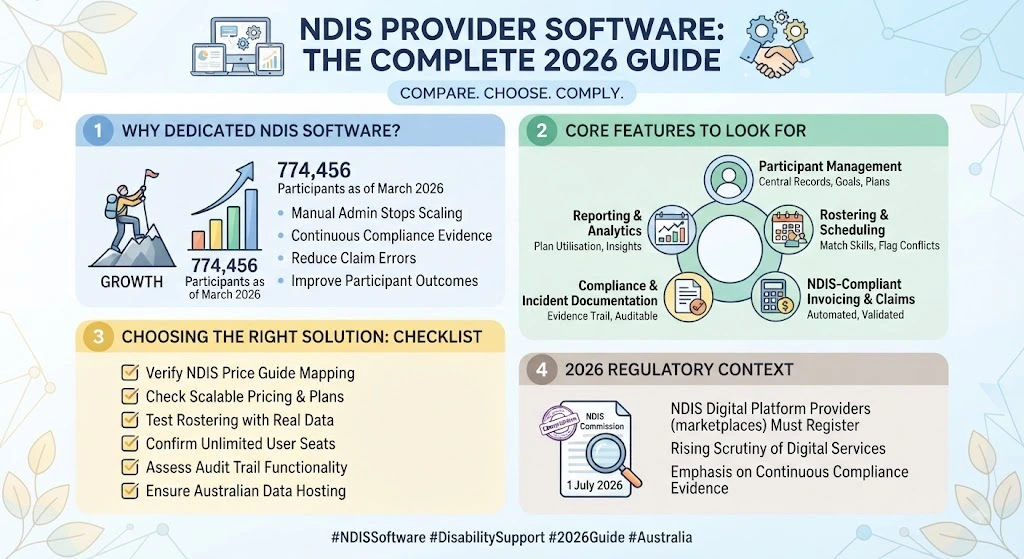
- The NDIS supported 774,456 participants as at 31 March 2026, and the provider market keeps growing — manual admin stops scaling well before that point.
- From 1 July 2026, NDIS digital platform providers (online marketplaces) must register with the NDIS Quality and Safeguards Commission — a separate requirement from choosing practice management software, but a sign that scrutiny of NDIS-related digital services is rising.
- Solid NDIS management software covers five things well: participant management, rostering, invoicing/claims, compliance documentation and reporting.
- Australian pricing typically runs from around $40 a month for small providers to custom enterprise pricing, often on flat-rate, unlimited-user models.
Introduction
NDIS provider software has become baseline infrastructure for Australian disability support businesses, not an optional upgrade. As at 31 March 2026, the NDIS was supporting 774,456 participants with approved plans, and around 59,000 new participants joined the Scheme this financial year alone. Provider numbers have grown alongside that, and running rostering, participant files and NDIS claims from spreadsheets and email threads stops being sustainable long before a provider reaches a few hundred participants.
The Scheme also carries strict compliance expectations. The NDIS Quality and Safeguards Commission increasingly expects registered providers to produce evidence-based records on demand, not only at audit time. This guide covers what NDIS provider software actually does, the features worth paying for, realistic Australian pricing, how to choose between NDIS software solutions, and where the new 2026 registration rules for digital platforms fit into the picture.
What Is NDIS Provider Software?
NDIS provider software is a digital system that NDIS providers use to manage participant records, rostering, service agreements, NDIS-compliant invoicing and compliance documentation in one place. Often called NDIS management software, it replaces spreadsheets and paper files, and helps providers evidence their obligations under the NDIS Practice Standards.
In practice, most Australian providers start with a mix of tools — a spreadsheet for rostering, a separate accounting package for invoices, a shared drive for incident forms, and a paper diary for participant notes. NDIS provider software brings those functions together so participant, financial and compliance data live in one auditable system, rather than being reconstructed from memory when the NDIS Commission asks for evidence.
Expert commentary: the shift isn't really about technology preference — it's about auditability. A provider that can pull a complete participant record, roster history and claim trail in minutes is in a fundamentally different position at renewal audit than one piecing it together from several systems.
Why NDIS Providers Need Dedicated Software in 2026
NDIS providers need dedicated software in 2026 because participant numbers keep growing, the NDIS Commission has moved toward continuous, evidence-based compliance monitoring rather than periodic checks, and manual processes create errors in claims, rostering conflicts and missing incident documentation that put registration at risk.
Scheme growth is outpacing manual admin
The NDIS Quarterly Report for the third quarter of 2025–26 recorded 774,456 participants with approved plans, an increase of around 13,000 participants in that quarter alone, with more than 18,500 new participants entering the Scheme. That growth compounds for providers: more participants means more service agreements, more rostered shifts, and more claims to track without errors.
Regulatory change is genuinely new information for 2026
From 1 July 2026, providers operating an NDIS digital platform — an online marketplace connecting participants with support workers — must register with the NDIS Quality and Safeguards Commission. This is important to understand correctly: it applies to platform providers (marketplaces), not to vendors of internal practice management software like rostering or invoicing systems. A provider using NDIS management software to run its own operations doesn't trigger this requirement by using the software; the requirement is about how a business connects participants with workers.
Even so, the reform signals where NDIS regulation is heading — toward continuous compliance evidence rather than point-in-time audits. Every provider, registered or not, benefits from systems that can produce that evidence on demand.
“A higher bar for providers of these critical, high-risk disability support services” — Senator Jenny McAllister, Minister for the NDIS, on the 2026 mandatory registration reforms.
“Greater visibility of providers delivering higher-risk services” — Louise Glanville, NDIS Quality and Safeguards Commissioner, on the purpose of mandatory registration.
Core Features to Look For in NDIS Management Software
The core features of NDIS management software are participant management, rostering and scheduling, NDIS-compliant invoicing and claims, compliance and incident documentation, and reporting. Providers should treat these as a checklist, not a wish list — missing any one of them usually means a second tool creeping back in.
Participant management
A central participant record should hold plan details, goals, funding categories, consent forms and case notes — searchable, not buried in folders. This is the record the NDIS Commission and participants themselves will expect to see evidence from.
Rostering and scheduling
Shift rostering needs to match support workers to participants by qualification, availability and location, and flag conflicts before they become missed shifts. For providers running Supported Independent Living or high shift volumes, this is usually the single biggest time saver.
NDIS-compliant invoicing and claims
Invoicing needs to map to NDIS support item numbers and price limits, and ideally submit claims in the format the NDIA's claims systems expect. Errors here cause payment delays and rework — a common, avoidable cost for smaller providers.
Compliance and incident documentation
The system should log incidents, complaints and their resolution against the NDIS Practice Standards, so a provider can show a complete trail rather than reconstructing it from memory during an audit.
Reporting and analytics
Dashboards covering plan utilisation, staff hours, outstanding claims and upcoming renewals help a provider run the business proactively, rather than discovering a lapsed service agreement after the fact.
NDIS Software Solutions vs Spreadsheets and Generic Tools
Generic tools — spreadsheets, calendar apps, standard accounting software — can work for a very small provider with a handful of participants. The trade-offs become clear as a provider scales:
| Factor | Spreadsheets / generic tools | Purpose-built NDIS provider software |
| NDIS support item mapping | Manual, error-prone | Built in, updated with price guide changes |
| Audit evidence | Scattered across files and inboxes | Centralised, exportable records |
| Rostering conflicts | Caught manually, if at all | Flagged automatically |
| Scaling to more participants | Breaks down quickly | Designed to scale |
| Ongoing cost | "Free" but hidden in staff time | Flat monthly fee, predictable |
How to Choose NDIS Provider Software: A Practical Checklist
To choose NDIS provider software, confirm it covers NDIS-specific invoicing and support item numbers, check how it handles compliance evidence, test rostering with a realistic shift load, confirm pricing scales sensibly with participant numbers, and check for unlimited user seats before signing a contract.
- List the non-negotiables: NDIS support item numbers, PACE-compatible claiming, incident logging against the Practice Standards.
- Check how pricing scales — per-participant tiers are common; per-user pricing can get expensive fast for growing teams.
- Ask for a trial with real participant and roster data, not a demo dataset.
- Check what a renewal audit export actually looks like before you need one.
- Confirm data is hosted in Australia or otherwise meets the provider's own privacy obligations.
- Check onboarding and support — migrating participant records is the highest-risk step.
Common Mistakes Providers Make When Choosing Software
- Buying on price alone and discovering per-user fees balloon as the team grows.
- Skipping a real data migration test, then losing participant history in the switch.
- Choosing generic project-management or CRM tools that don't map to NDIS support items.
- Assuming any "NDIS software" automatically satisfies NDIS Commission audit requirements — it reduces admin risk, but compliance is still the provider's responsibility.
What Does NDIS Provider Software Cost in Australia?
NDIS provider software in Australia typically costs from around $40 a month for a small provider on a flat-rate plan, scaling to a few hundred dollars a month for mid-sized providers, with custom enterprise pricing for large providers with unlimited participants.
Pricing models vary — some vendors charge per user, which penalises growing teams; others use flat-rate tiers based on participant numbers with unlimited staff logins. As an example, Ausvanta, the NDIS management software built by Cognify Digital, prices this way:
| Plan | Indicative monthly price | Participants | Users |
| Starter | $40 | Up to 20 | Unlimited |
| Essential | $70 | Up to 50 | Unlimited |
| Professional | $130 | Up to 150 | Unlimited |
| Business | $250 | Up to 500 | Unlimited |
| Enterprise | From $349 (POA) | Unlimited | Unlimited |
Ausvanta covers participant management, compliance, rostering, billing and reporting in one platform, with unlimited users on every plan — so headcount growth doesn't push up the software bill on its own. Pricing and inclusions should always be confirmed on the vendor's current pricing page before a purchasing decision, since NDIS software pricing changes as products evolve.
Illustrative Example: How Software Changes a Provider's Week
(Illustrative scenario, not a documented client case study.) Picture a growing provider with 60 participants, still running rostering from a spreadsheet and invoices through separate accounting software. A missed roster clash means a double-booked support worker; an invoice goes out with the wrong support item number and gets rejected, delaying payment by weeks. Moving participant records, rostering and NDIS-compliant invoicing into one system doesn't remove the admin work entirely, but it catches the roster clash before the shift and maps the invoice to the correct item automatically — the kind of everyday error that purpose-built NDIS management software is designed to prevent.
Frequently Asked Questions
What is NDIS provider software?
NDIS provider software is a system for managing participant records, rostering, NDIS-compliant invoicing and compliance documentation for disability support providers in one platform.
How is NDIS management software different from general business software?
It maps directly to NDIS support item numbers, claim formats and the NDIS Practice Standards, which generic CRM, accounting or scheduling tools don't handle natively.
Do unregistered NDIS providers need this software too?
Yes. Unregistered providers serving self-managed or plan-managed participants still benefit from accurate invoicing, rostering and record-keeping, even without formal Commission audits.
What does NDIS provider software cost in Australia?
Pricing commonly starts around $40 a month for small providers on flat-rate plans, rising to custom enterprise pricing for large providers — always confirm current pricing with the vendor.
Does using NDIS software mean a provider is automatically compliant?
No. Software reduces admin errors and centralises evidence, but meeting the NDIS Practice Standards remains the provider's responsibility.
What is the 1 July 2026 NDIS registration change?
From 1 July 2026, providers operating an NDIS digital platform (an online marketplace connecting participants and support workers) must register with the NDIS Quality and Safeguards Commission.
Does the 2026 registration change apply to practice management software vendors?
No. It applies to platform providers that connect participants with support workers, not to vendors selling internal rostering, invoicing or compliance software to providers.
Can NDIS provider software handle rostering for Supported Independent Living (SIL)?
Most purpose-built NDIS management software includes rostering suited to SIL's higher shift volumes and staff-to-participant matching needs, though features vary by vendor.
How many people currently use the NDIS?
As at 31 March 2026, the NDIS supported 774,456 participants with approved plans, according to the NDIA's Quarterly Report.
What should a provider check before switching NDIS software?
Test rostering and invoicing with real data, confirm pricing scales sensibly with participant growth, and check how easily a compliance audit export can be generated.
Conclusion
NDIS provider software isn't a single feature or a nice-to-have dashboard — it's the operational backbone that lets a provider handle more participants without more admin errors, and produce compliance evidence without a scramble. With participant numbers still climbing and the NDIS Commission moving toward continuous compliance evidence, the providers still running rostering and invoicing from spreadsheets are the ones most exposed.
Cognify Digital builds Ausvanta, all-in-one NDIS management software covering participant management, rostering, compliance, billing and reporting, with unlimited users on every flat-rate plan. Explore the current pricing and features on the Ausvanta page, or get in touch with the Cognify Digital team to talk through what a switch would look like for your provider.



0 Comments