

Key Takeaways
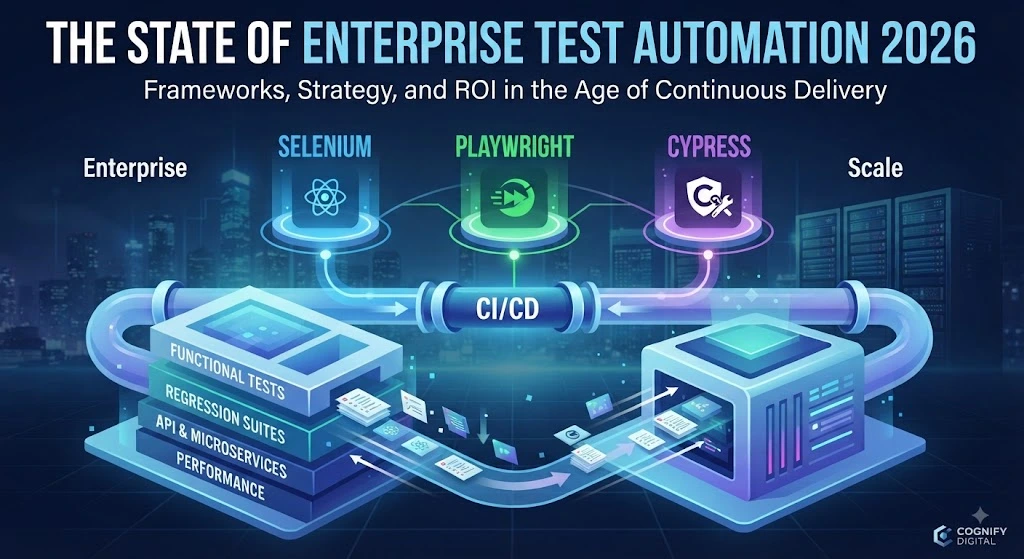
- Enterprise test automation is the practice of using frameworks, tooling and CI/CD pipelines to run functional, regression, API and performance tests automatically and at scale.
- Selenium remains the enterprise standard for polyglot teams and legacy browser coverage; Playwright has become the strongest default for new web projects thanks to speed and auto-waiting; Cypress suits JavaScript-heavy front-end teams.
- Analyst estimates put the global test automation market in the tens of billions of dollars in 2026, with most enterprises already running some level of automated testing and many planning to expand it further.
- Most mature enterprises run more than one framework rather than betting everything on a single tool.
- A successful strategy depends less on the framework chosen and more on governance, maintainability and how well testing is integrated into the CI/CD pipeline.
Enterprise test automation only pays off when it is treated as an engineering discipline, not a tool purchase. Teams that pick a framework without a maintenance plan, ownership model and CI/CD integration strategy tend to accumulate flaky, expensive test suites — regardless of whether they chose Selenium, Cypress or Playwright.
What Is Enterprise Test Automation?
Enterprise test automation is the use of automated frameworks, scripts and CI/CD integration to test large-scale, often complex software systems across multiple teams, environments and technology stacks, without relying on manual regression testing. It differs from general test automation mainly in scope: enterprise contexts add governance, compliance, multi-team ownership and integration with legacy systems into the mix.
At small scale, a single developer might write a handful of automated tests around a new feature. At enterprise scale, hundreds or thousands of automated tests run across web, mobile, API and desktop layers, owned by multiple squads, and gated into every release through a CI/CD pipeline. That difference in scale is what drives most of the framework and process decisions covered in this guide.
Why Enterprise Test Automation Matters Right Now
Analyst estimates for the global automation testing market vary, but most 2026 reports place it in the mid-to-high tens of billions of US dollars, with consistent double-digit annual growth forecast through the early 2030s as enterprises shift testing earlier into the development lifecycle and adopt continuous testing. The figures differ by research house because they scope the market differently, but the direction is consistent: enterprise investment in automated testing is accelerating, not slowing down.
A few patterns show up repeatedly across current industry research:
- A majority of enterprises already run some form of test automation, and a large share plan to materially increase automated coverage over the next year.
- Large organisations still account for the bulk of market spend, though small and medium enterprises are the fastest-growing adopter segment.
- Interest in AI-assisted testing — self-healing scripts, automatic test generation and defect prediction — is rising sharply, with a large majority of enterprises planning to adopt some form of AI-powered testing tooling within the next couple of years.
- Web testing still accounts for the majority of automated test activity, but API and microservices testing is the fastest-growing category as architectures move toward distributed services.
For Australian businesses specifically, the pressure is compounding: faster release cycles driven by competitive SaaS markets, tighter data-handling expectations in regulated sectors like finance and health, and a persistent shortage of experienced QA engineers. Automation is less a nice-to-have and more the only realistic way to keep quality bar high while releasing weekly or daily.
Selenium vs Cypress vs Playwright: The Core Comparison
Selenium suits polyglot enterprise teams and legacy browser coverage; Playwright is now the strongest default for new web projects due to speed and reliability; Cypress offers the smoothest developer experience for JavaScript-only front-end teams but has narrower browser support. There is no single "best" framework — the right choice depends on your existing stack, language mix and browser coverage requirements.
| Factor | Selenium | Cypress | Playwright |
|---|---|---|---|
| Best for | Polyglot enterprise teams, legacy apps | JavaScript/TypeScript front-end teams | Modern SPAs, new projects, cross-browser needs |
| Language support | Java, Python, C#, Ruby, JavaScript, PHP | JavaScript/TypeScript only | JavaScript/TypeScript, Python, Java, .NET |
| Browser coverage | Widest, including older browser versions | Chromium and Firefox; limited Safari | Chromium, Firefox and WebKit (Safari engine) |
| Architecture | WebDriver protocol (HTTP per command) | Runs inside the browser | Direct browser protocol connection |
| Parallel execution | Needs a grid or cloud provider | Supported, often at extra cost via Cypress Cloud | Built in, free |
| Maturity | ~20 years, largest legacy footprint | Strong since ~2017, dev-experience focus | Newer, fastest-growing adoption since 2023–2024 |
| Typical fit | Regulated/legacy enterprise, mixed tech stacks | Fast-moving JS product teams | Greenfield builds needing speed and full browser coverage |
Expert commentary: In practice, the framework debate matters less than most teams assume. A polyglot enterprise with a working Selenium suite and a Java-heavy engineering org rarely benefits from a wholesale rewrite. The more valuable question is usually: where is this specific test suite flaky, slow or expensive to maintain, and does a different tool actually fix that — or just move the problem?
A few things to note when comparing the three:
- Selenium's WebDriver architecture sends a network request for every browser action, which is part of why it tends to run slower than Playwright's direct protocol connection — but it also means Selenium works with almost any language and CI setup already in place.
- Cypress's biggest architectural trade-off is that it runs inside the browser itself, which makes debugging easier but limits true multi-tab and multi-origin testing compared with Playwright.
- Playwright's auto-waiting mechanism — automatically waiting for elements to be actionable rather than requiring explicit waits — is one of the most commonly cited reasons teams report fewer flaky tests after migrating.
- Many enterprises run a hybrid approach: Playwright or Cypress for modern web and API testing, alongside Selenium (or a dedicated tool) for legacy desktop, SAP or Appium-based mobile testing — rather than standardising on one framework enterprise-wide.
How to Choose the Right Test Automation Framework
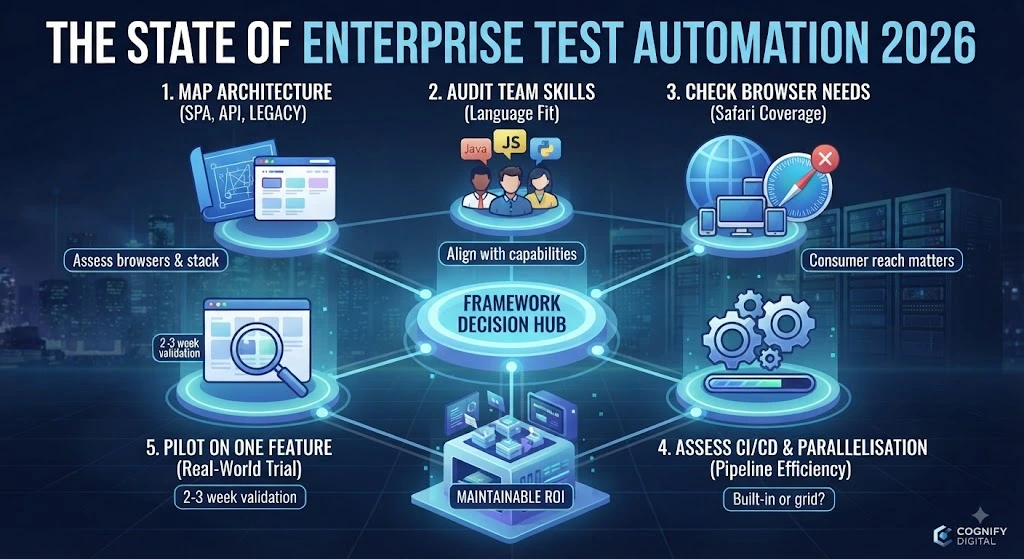
Start from your application architecture and existing team skills, not from framework popularity. A five-step evaluation keeps the decision grounded in what your team will actually maintain.
- Map your application architecture: single-page app, API-first, or legacy multi-page system, and which browsers your users actually run.
- Audit language and skills fit: a Java-heavy backend team will ramp up on Selenium far faster than on a JavaScript-only tool.
- Check cross-browser and device requirements: Safari and WebKit coverage rules out Cypress for many consumer-facing Australian brands.
- Assess CI/CD and parallelisation needs: built-in parallel execution (Playwright) can materially cut pipeline run time versus paying for a grid.
- Pilot on one real feature area before committing enterprise-wide: run a two-to-three week trial against an existing, high-value test suite rather than a synthetic demo.
Building an Enterprise Test Automation Strategy
A framework decision is a small part of a working strategy. The bigger determinants of ROI are governance, ownership and how deeply testing is wired into delivery.
1. Integrate testing into CI/CD, not around it
Automated tests only deliver value when they gate releases automatically. That means wiring your chosen framework into your CI/CD pipeline so failing tests block a deployment rather than surfacing after the fact — a core part of how mature teams structure DevOps and cloud delivery.
2. Assign clear ownership
Enterprise test suites decay fastest when no one owns them. Successful teams assign specific squads or a dedicated QA function responsibility for specific suites, with a maintenance budget built into sprint planning — not treated as leftover capacity.
3. Design for maintainability from day one
- Use the Page Object Model or an equivalent abstraction layer so a UI change requires one edit, not dozens.
- Separate test data from test logic to avoid brittle, hard-coded scripts.
- Track flaky test rate as a first-class metric, alongside pass rate and coverage.
4. Layer your test types deliberately
Enterprise suites that lean entirely on slow, brittle end-to-end UI tests are a common and costly mistake. A better-balanced approach favours a larger base of fast unit and API tests, with a smaller, more selective layer of UI end-to-end tests reserved for critical user journeys.
5. Plan for AI-assisted testing, carefully
AI-powered features — self-healing locators, automatic test generation, visual regression detection — are moving from experimental to mainstream across enterprise QA tooling. They reduce maintenance overhead, but they still need human review; treat AI-generated tests as a first draft, not a finished asset.
Common Mistakes in Enterprise Test Automation
- Automating everything at once instead of prioritising high-risk, high-traffic user journeys first.
- Choosing a framework based on trend articles rather than the team's actual language stack and browser requirements.
- Treating test automation as a one-off project instead of an ongoing engineering discipline with its own backlog.
- Ignoring flaky tests instead of fixing or removing them — flaky suites erode trust and get skipped, quietly defeating the purpose of automation.
- Running automated UI tests without integrating them into CI/CD, so failures are discovered days after the code merged.
What Does Enterprise Test Automation Cost in Australia?
Costs vary widely by scope, but three components consistently drive the budget: framework and tooling (open-source frameworks like Selenium, Cypress and Playwright are free, but cloud device/browser grids and reporting platforms carry licence fees), engineering time to build and maintain suites, and CI/CD compute for running tests in the pipeline. Enterprise buyers evaluating dedicated commercial test-automation platforms should weigh licence costs against what a well-architected open-source stack can already deliver — vendor support contracts are not always the deciding factor teams assume they are.
For most mid-sized to large Australian businesses, the realistic budget conversation is less about which framework is "free" and more about the ongoing cost of skilled QA automation engineering — which is where partnering with an experienced delivery team tends to shorten the path to a stable, maintainable suite.
A Practical Example: Regression Testing at Release Velocity
Consider a typical enterprise scenario: a retail or fintech platform releasing weekly, with a regression suite that previously took a manual QA team two to three days to complete. Moving core regression coverage into an automated Playwright or Selenium suite, integrated into the CI/CD pipeline, typically compresses that cycle to hours rather than days — freeing manual testers to focus on exploratory and usability testing where human judgement adds the most value. This pattern, rather than any single framework, is what most enterprise automation programs are actually chasing: faster, more reliable releases without sacrificing quality.
Expert Perspectives on Testing
Computer scientist Edsger W. Dijkstra's often-cited observation still shapes how mature QA teams think about coverage: “Testing shows the presence, not the absence of bugs.” It is a useful check against overconfidence — a green test suite reduces risk, but it never eliminates it.
Kent Beck, creator of Extreme Programming and a pioneer of test-driven development, put the practical trade-off just as plainly: “I get paid for code that works, not for tests.” For enterprise teams, that is a reminder to automate in service of shipping reliable software, not to chase coverage numbers for their own sake.
Frequently Asked Questions
What is enterprise test automation?
Enterprise test automation is the use of automated frameworks and CI/CD integration to run functional, regression, API and performance tests across large, multi-team software systems without relying on manual regression testing.
How is enterprise test automation different from regular test automation?
The core techniques are the same, but enterprise contexts add scale, multi-team ownership, legacy system integration, compliance requirements and governance that smaller projects usually don't need to manage.
Which is better: Selenium, Cypress or Playwright?
None is universally better — Selenium suits polyglot enterprise teams and legacy browser coverage, Playwright is the strongest default for new web projects, and Cypress offers the best developer experience for JavaScript-only teams.
Can enterprises use more than one test automation framework?
Yes — a majority of enterprises now report using a multi-framework approach, commonly pairing a modern web framework with Selenium or Appium for legacy or mobile coverage.
Why do automated test suites become flaky over time?
Flaky tests usually stem from poor waiting strategies, brittle selectors, shared test data or environment instability rather than the framework itself — which is why maintainability practices matter more than the tool choice.
How much does enterprise test automation cost?
Framework licensing is typically free for open-source tools, but total cost depends on engineering time, cloud device/browser grids, CI/CD compute and any commercial platform licences an enterprise chooses to add.
Should test automation run in the CI/CD pipeline?
Yes — tests that don't run automatically on every merge or deployment provide far less value, since failures are caught late rather than blocking a risky release.
What is the benefit of AI-powered test automation?
AI-assisted features like self-healing locators and automatic test generation can reduce maintenance overhead and flaky-test rates, though outputs still need human review before being trusted in production suites.
Do enterprises still use Selenium in 2026?
Yes — Selenium remains widely used in polyglot enterprise environments, regulated industries and teams with existing large test suites, even as Playwright leads adoption among new, greenfield projects.
How do I start building an enterprise test automation strategy?
Begin with a small, high-value pilot on an existing test suite, choose a framework based on your team's language stack and browser needs, then scale gradually with clear suite ownership and CI/CD integration from the outset.
Where to Go From Here
Choosing between Selenium, Cypress and Playwright is only the first decision in a working enterprise test automation strategy. If you're weighing framework options or looking to build (or rebuild) a maintainable QA pipeline, Cognify Digital's Quality Assurance team runs ISTQB-certified functional, performance, mobile and API test automation on every engagement — including Playwright, Selenium, Cypress and Appium.
Explore our full software development and QA services, or
get in touch to talk through your current testing setup and where automation could realistically save your team the most time.


0 Comments