
Key Takeaways
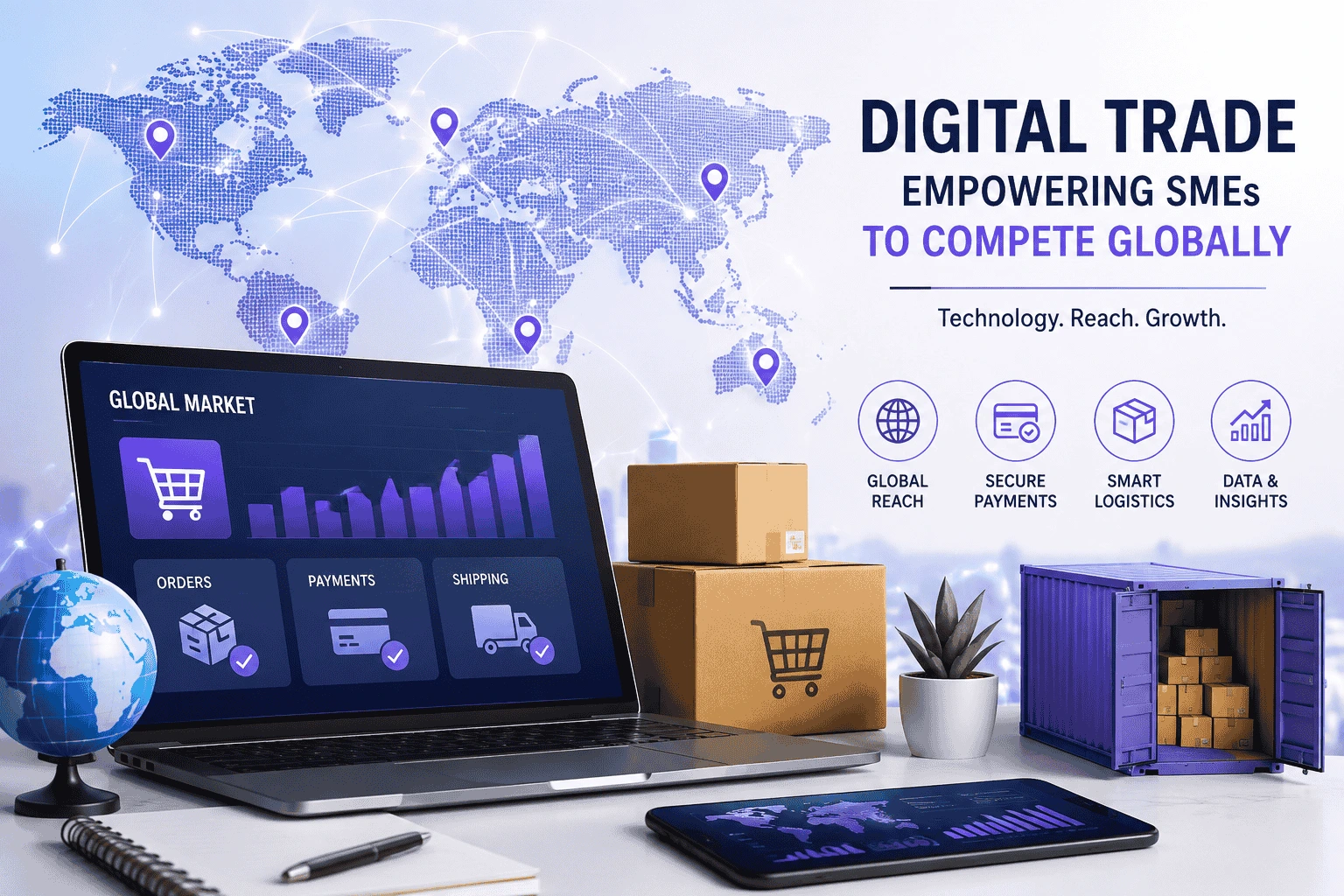
- Digital trade solutions — e-commerce platforms, cloud infrastructure, automated compliance, AI-driven insights and digital marketing — let small and medium enterprises (SMEs) reach overseas buyers without the overheads that once made global trade an enterprise-only game.
- Australia's services and digitally delivered exports are a growing share of national trade, and government-backed digital trade policy is actively encouraging SMEs to participate.
- Programs like the Export Market Development Grants (EMDG) offer matched funding SMEs can put directly toward digital market-entry activity.
- The biggest barriers for SMEs aren't capital or size — they're visibility, trust-building and operational complexity, all of which digital tools are specifically built to solve.
- A staged approach (start with one market, one channel, one platform) beats trying to digitise everything at once.
For decades, going global was something only big businesses could afford to do — the shipping contracts, the compliance teams, the overseas offices. That's no longer the barrier it used to be. Today, a ten-person business in regional Victoria can list products on a marketplace in Singapore, take payment in local currency, and have a parcel moving through customs by the afternoon — all without hiring a single new person. This is the practical answer to how digital trade solutions empower SMEs to compete globally: they replace the fixed costs of international expansion (people, offices, paperwork) with software that scales up or down as needed. This guide breaks down what digital trade solutions actually are, why they matter for Australian SMEs specifically, and how to start using them without overhauling your whole business at once.
What Are Digital Trade Solutions?
Digital trade solutions are the software, platforms and digital services that let a business market, sell, transact with, and support customers in other countries — without needing a physical presence there. This spans e-commerce storefronts and marketplaces, cross-border payment gateways, cloud-based logistics and inventory tools, AI-powered translation and customer service, and digital marketing systems that build visibility in a new market. For an SME, the appeal is that most of these tools are subscription-based and modular: you adopt what you need for the market you're entering, rather than building enterprise-scale infrastructure upfront.
Why This Matters for SMEs Right Now
Global trade is shifting toward digital delivery. Recent estimates from the World Trade Organization and International Trade Centre show global digitally delivered trade climbing from around US$3.21 trillion to US$4.64 trillion between 2020 and 2024 — a clear signal that the fastest-growing part of world trade is exactly the part SMEs can access through software rather than shipping containers, as detailed in the WTO's work on digital technologies and trade. In Australia specifically, DFAT's services and digital trade data shows services exports reached roughly $126 billion in 2024, close to a fifth of the country's total exports — and digital delivery is a growing part of that mix. For an SME owner, that's not an abstract statistic; it means the buyers, marketplaces and payment rails are already there, actively looking for suppliers.
The Core Problem SMEs Face — And How Technology Solves It
What's the biggest barrier for SMEs going global? It's rarely product quality. It's visibility, trust and the operational load of managing a market you can't physically visit. Below is how specific technology categories address each.
Visibility: Being Found by Overseas Buyers
Traditional exporting relied on trade shows, distributor relationships and cold outreach. Digital marketing — technical SEO, AEO-optimised content, paid search, and marketplace SEO — lets an SME be discoverable to a buyer in Jakarta or Auckland searching for exactly what they sell, at a fraction of the cost of a trade mission. Cognify Digital's digital marketing services are built around this kind of visibility work — technical and content SEO paired with analytics so a business can see which overseas markets are actually converting.
Trust: Looking Credible to a Buyer Who Has Never Met You
Overseas buyers can't walk into your showroom. A fast, secure, mobile-optimised website or storefront — with clear policies, local currency pricing and responsive support — does the trust-building work a face-to-face meeting used to do. This is where solid web development and e-commerce foundations matter more for exporters than for domestic-only businesses, because the website is the first (and sometimes only) impression.
Operational Complexity: Payments, Compliance, Logistics
Multi-currency payment gateways, automated tax/duty calculation, and cloud-based inventory systems remove the manual work that used to require a dedicated export administrator. Cloud infrastructure also means a small team can run 24/7 operations across time zones without being awake for all of them.
Insight: Knowing Which Market to Prioritise
AI and data tools now let SMEs analyse demand signals, competitor pricing and customer behaviour across markets before committing serious budget to any one of them — turning "we think Southeast Asia looks promising" into an evidence-based decision.
Five Digital Trade Solution Categories SMEs Should Know
1. E-Commerce and Marketplace Platforms
What are they? Storefronts (Shopify, WooCommerce, headless commerce) and marketplaces (Amazon Global, eBay International, Alibaba) that let an SME list and sell products internationally without a local retail presence. Best used alongside localised product pages, multi-currency pricing and region-specific shipping rules rather than a single generic listing pushed to every market.
2. Cross-Border Payment and Fintech Tools
What are they? Multi-currency accounts, digital wallets and FX-hedging tools that let SMEs receive payment in a buyer's currency and settle in their own, reducing conversion losses and delays. These matter because working-capital strain is one of the most common reasons SMEs stall out on early export deals — a straightforward point Australian trade-finance analysis has flagged, noting SMEs typically face tighter financing constraints than larger exporters when entering new markets.
3. Cloud Infrastructure and Automation
What are they? Cloud-hosted systems for inventory, order management and customer service that scale with demand and don't require in-house servers. Cognify Digital's cloud and DevOps work is an example of the kind of scalable, always-on infrastructure exporters rely on to serve customers across time zones reliably.
4. AI and Data Analytics
What are they? Tools that translate content, personalise the buying experience, forecast demand by region, and flag which markets are worth pursuing next. Cognify Digital's AI and machine learning capability covers exactly this kind of predictive and personalisation work.
5. Digital Compliance and Documentation Tools
What are they? Software that automates customs paperwork, certificates of origin and tax documentation — reducing the administrative burden that used to require specialist export staff.
How Digital Trade Solutions Compare to Traditional Export Methods
| Factor | Traditional Export Approach | Digital Trade Solutions |
| Market entry cost | High (offices, agents, trade missions) | Low-to-moderate (subscriptions, platform fees) |
| Time to first sale | Months | Weeks |
| Scalability | Requires new hires/offices per market | Same team, more markets |
| Visibility to buyers | Trade shows, distributor networks | SEO, marketplaces, paid search — always on |
| Payment friction | Manual FX, delayed settlement | Multi-currency accounts, faster settlement |
| Compliance handling | Manual, specialist-dependent | Increasingly automated |
Government Support: Digital Trade Isn't a Solo Effort
Australian SMEs don't have to fund this shift entirely on their own. The Export Market Development Grants (EMDG) program, run by Austrade, offers matched funding for export marketing and promotional activity — which explicitly includes digital marketing and market-entry costs. Under the current round, Austrade's EMDG eligibility guidance sets out three SME tiers: Tier 1 for businesses ready to export, Tier 2 for those exporting within existing markets, and Tier 3 for those expanding into new key markets, with grant amounts running from $20,000 up to $80,000 per financial year as matched funding, according to business.gov.au's EMDG overview. This is one of the more overlooked levers for SMEs building out a digital export strategy: the cost of a new export-focused website, SEO campaign or marketplace launch can be partly offset by a grant designed for exactly that purpose.
Beyond EMDG, Australia's network of free trade agreements reduces tariffs and simplifies compliance across many of the markets SMEs are most likely to target, lowering the practical barrier to entry that digital tools then help SMEs actually act on.
A Step-by-Step Approach for SMEs Starting Out
How should an SME start with digital trade solutions? Start narrow, not broad. Pick one target market, one sales channel and one platform, prove it works, then expand — rather than trying to digitise every part of the export process simultaneously.
- Pick one target market based on existing demand signals — inbound website enquiries, marketplace search data, or an existing customer base with regional ties — rather than guessing.
- Get the digital foundations right first: a fast, mobile-friendly, SEO-structured website or storefront that can handle the currency and language needs of that one market.
- Add a single payment/logistics layer suited to that market rather than building out global infrastructure on day one.
- Invest in visibility — SEO and content built around how buyers in that market actually search, plus AEO-style content structured for AI answer engines, which is increasingly how B2B buyers discover suppliers.
- Check grant eligibility before spending — EMDG and similar programs can offset a meaningful share of the marketing investment.
- Review data monthly and expand to a second market only once the first is generating consistent, profitable enquiries.
Common Mistakes SMEs Make With Digital Trade Solutions
- Translating a website instead of localising it — swapping language without adjusting currency, measurement units, payment methods or cultural expectations.
- Choosing a platform before choosing a market — the tool should follow the strategy, not the other way around.
- Ignoring page speed and mobile experience — many high-growth export markets are majority mobile-first for purchasing.
- Underestimating compliance — assuming digital sales bypass customs or tax obligations, which they don't.
- Treating SEO/AEO as optional — in markets where you have no existing brand recognition, being found in search and AI-generated answers is often the entire strategy.
Frequently Asked Questions
What are digital trade solutions? Digital trade solutions are software and platforms — e-commerce, payments, cloud, AI and digital marketing tools — that let a business sell and operate internationally without a physical presence in each market.
How do digital trade solutions help small businesses compete globally? They lower the fixed costs of international expansion, replacing offices, agents and manual admin with subscription-based tools that scale with demand.
Why should an SME consider exporting through digital channels? Digitally delivered global trade is growing quickly, and Australian government data shows services and digital trade already make up a large share of national exports — the demand is there and increasingly reachable through digital-first strategies.
Can a small business afford digital trade solutions? Yes — most platforms are modular and subscription-based, and Australian SMEs can also access matched funding through programs like EMDG to offset market-entry costs.
What is the cost of not adopting digital trade tools? The main cost is opportunity: competitors reaching international buyers first through better visibility, smoother payment experiences and faster market entry.
Should an SME start with e-commerce or with digital marketing first? Generally, the foundation (a fast, well-structured website or storefront) should come before the marketing spend — otherwise traffic arrives with nowhere effective to convert.
What's the difference between digital trade and traditional exporting? Traditional exporting typically requires physical presence, distributor relationships and manual documentation; digital trade shifts most of this to software, cutting time-to-market and cost.
Who can help an SME get started with digital trade solutions? A digital partner experienced in export-ready web builds, cloud infrastructure and SEO/AEO content — such as Cognify Digital — can shorten the learning curve considerably.
Are there government grants for SME digital export activity? Yes — Austrade's Export Market Development Grants provide matched funding for export marketing and promotional activities, including digital-first strategies.
When is the right time for an SME to start investing in digital trade solutions? As soon as there's a validated signal of overseas demand — inbound enquiries, marketplace traction, or a clear competitor gap — rather than waiting until the business feels "big enough."
The Bottom Line
Digital trade solutions have removed the size requirement from global trade. What matters now is sequencing: getting a credible digital foundation in place, choosing one market with real demand signals, and building visibility deliberately — with government support like EMDG available to soften the cost. For SMEs weighing where to start, a conversation with a team that builds export-ready web, cloud and AI infrastructure day-to-day is a low-risk way to map out the first move. Cognify Digital works with growing businesses on exactly this kind of build — web, cloud, AI and the SEO/AEO content that makes them findable.

0 Comments