
Key Takeaways
- Digital solutions are technology-based tools, platforms or services — software, apps, cloud systems, AI and automation — used to solve a specific business problem or improve how a business operates.
- They differ from “digital transformation,” which is the broader strategic shift; a digital solution is one practical piece of that shift.
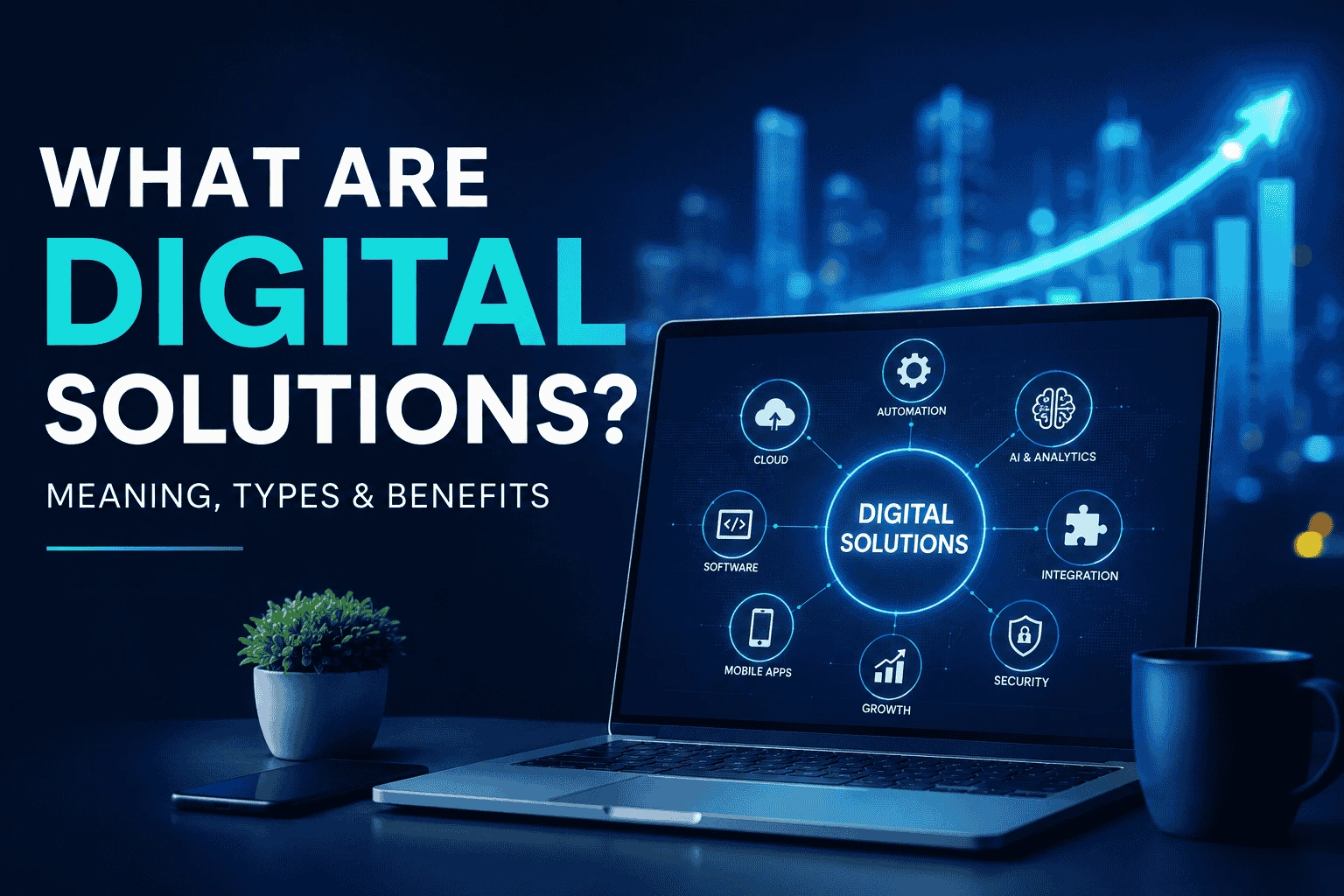
- Common types include web and app solutions, AI and automation, cloud infrastructure, e-commerce and digital marketing systems.
- Costs vary widely by scope — from a few thousand dollars for a simple tool to six figures for a custom platform.
- The right partner matters more than the tool: look for relevant experience, clear scoping and post-launch support.
If you've searched “what are digital solutions” and found ten different answers, you're not alone. The term gets used for everything from a simple booking app to a full AI-powered platform, which makes it genuinely hard to know what you're being sold — or what you actually need. This guide gives you a plain-English definition, breaks down the main types of digital solutions, compares the term to “digital transformation” and “digital products,” and walks through realistic costs and how to choose a partner, so you can talk to a provider with confidence instead of guesswork.
What Are Digital Solutions?
| Digital solutions are technology-based products or services — software, websites, apps, cloud systems, automation or AI tools — built to solve a specific business problem, such as slow processes, poor customer experience or manual data work. They replace or upgrade a manual task with a digital one. |
At its core, a digital solution is any technology that closes a gap between how a business currently operates and how it needs to operate. That might mean replacing a paper-based booking system with an online scheduling tool, adding a chatbot to handle routine customer questions, or building custom software to connect two systems that don't currently talk to each other.
The word “solution” is doing real work in the phrase: it implies the technology exists to fix something, not just to look modern. A genuine digital solution should be judged against a business outcome — fewer support tickets, faster checkout, lower error rates, more repeat customers — rather than against how advanced the technology sounds.
What Does “Digital Solutions” Mean in Practice?
| In practice, digital solutions mean applying software, data and connected systems to a real operational problem: automating a manual task, moving a process online, connecting disconnected tools, or using data and AI to make faster decisions. |
Most digital solutions fall into one of a few practical jobs:
- Automating repetitive work — invoicing, rostering, follow-up emails
- Moving a process online — bookings, applications, payments, onboarding
- Connecting systems — syncing a CRM, website and accounting software so data isn't re-entered by hand
- Improving decision-making — dashboards and analytics that turn raw data into a clear next step
- Extending reach — e-commerce, mobile apps and digital marketing that let a business serve customers beyond its physical location
None of these require exotic technology. Australia's Digital Transformation Agency, which sets the framework for government digital investment, describes the goal in similarly practical terms: using digital tools and data to make services simpler, clearer and faster for the people using them — a definition of “digital” that applies just as well inside a private business.
Why Digital Solutions Matter for Australian Businesses
| Digital solutions matter because they directly affect cost, speed and customer experience — and competitors that adopt them well are winning share from those that don't. Australian IT spending and AI adoption have both continued to climb through 2026, and businesses that treat digital tools as core infrastructure, not optional extras, are better placed to keep up. |
Recent industry analysis points to Australian IT spending tracking toward roughly A$172 billion by 2026, with adoption of AI and automation tools accelerating across both large enterprises and small-to-medium businesses. At the same time, a widely cited digital skills gap — estimated in the hundreds of thousands of workers — means demand for well-implemented digital solutions is outpacing the supply of in-house expertise, which is precisely why more businesses now buy this capability from specialist partners rather than building it alone.
For an individual business, the practical stakes usually come down to three things: cost (manual processes and disconnected tools cost staff time every week), customer experience (customers increasingly expect self-service, fast responses and mobile-friendly interactions), and competitiveness (a rival that automates or digitises first can usually undercut on price or respond faster).
Types of Digital Solutions
| The main types of digital solutions are web and app development, e-commerce platforms, cloud and DevOps infrastructure, AI and automation, and digital marketing systems. Most businesses need a combination rather than a single tool. |
| Type | What it does | Typical use case |
|---|---|---|
| Web & app development | Custom websites, portals and applications built for a specific workflow | Customer portals, internal tools, SaaS products |
| E-commerce | Online storefronts and payment/checkout systems | Retail, subscriptions, marketplaces |
| Cloud & DevOps | Hosting, infrastructure and automated deployment pipelines | Scaling an app, improving uptime and release speed |
| AI & automation | Machine learning, chatbots, RAG assistants, workflow automation | Customer support, data processing, personalisation |
| Mobile apps | Native or cross-platform apps for iOS and Android | Loyalty, service booking, field operations |
| Digital marketing systems | SEO, paid media, analytics and marketing automation | Lead generation, brand visibility, retention |
Most real-world projects blend two or three of these. An online retailer, for example, typically needs e-commerce plus cloud hosting plus digital marketing working together — not one in isolation.
Digital Solutions vs Digital Transformation vs Digital Products: What's the Difference?
| Digital transformation is the overall strategic shift to digital ways of working. Digital solutions are the individual tools or systems used to achieve that shift. Digital products are solutions built to be sold or used repeatedly by many customers, rather than for one business's internal use. |
| Term | Scope | Example |
|---|---|---|
| Digital transformation | Company-wide strategy and culture change | A retailer restructuring its entire operating model around digital-first customer journeys |
| Digital solution | A specific tool or system solving one problem | Adding an online booking system to reduce phone enquiries |
| Digital product | A solution packaged to be sold or reused | A SaaS scheduling app sold to many different clinics |
In short: transformation is the strategy, a solution is the tool that delivers a piece of it, and a product is a solution built for scale.
How Digital Solutions Work: A Step-by-Step Overview
| Digital solutions are typically built in five stages: identifying the problem, designing the approach, building or configuring the technology, testing it, and rolling it out with ongoing support. Skipping the first and last stages is the most common reason projects underperform. |
- Diagnose the problem — define exactly what's slow, manual or broken before naming a technology
- Design the approach — map the workflow, choose build-vs-buy, and agree what success looks like
- Build or configure — develop custom software or configure an existing platform to fit
- Test — functional, performance and user testing before anything goes live
- Launch and support — roll out, train staff, and monitor so the solution keeps working as the business changes
Benefits of Digital Solutions
| The core benefits of digital solutions are time saved on manual work, fewer errors, better customer experience, clearer data for decision-making, and the ability to serve more customers without proportionally more staff. |
- Time savings — automating repetitive admin frees staff for higher-value work
- Fewer errors — removing manual data entry reduces mistakes and rework
- Better customer experience — self-service, faster responses and mobile access meet rising customer expectations
- Clearer decisions — dashboards and analytics replace guesswork with real numbers
- Scalability — cloud-based systems can grow with demand without a full rebuild
- Competitive positioning — businesses that digitise well can often move faster and price more sharply than those that don't
Common Mistakes Businesses Make with Digital Solutions
| The most common mistakes are choosing the technology before defining the problem, underestimating the cost of integration and staff training, skipping testing, and treating launch as the finish line instead of budgeting for ongoing support. |
- Buying a tool because it's trending, not because it fits an actual workflow
- Not budgeting for integration with existing systems — often the biggest hidden cost
- Underinvesting in staff training, so adoption stalls after launch
- Treating go-live as the end of the project rather than the start of ongoing support
- Skipping proper QA and security testing to save time
How to Choose the Right Digital Solutions Partner
| Choose a digital solutions partner based on relevant experience in your industry, a clear and itemised scope of work, transparency about ongoing support and cost, and evidence of quality assurance — not just the technology stack they mention. |
- Ask for examples of similar problems they've solved, not just industries they've served
- Get a written scope with milestones — vague proposals usually mean vague delivery
- Check how testing and quality assurance are handled before launch
- Clarify what happens after launch: is support, monitoring or maintenance included or billed separately
- Confirm who owns the code, data and any accounts once the project ends
How Much Do Digital Solutions Cost in Australia?
| Cost depends entirely on scope: a simple off-the-shelf tool or landing page can start in the low thousands, a custom web or mobile application typically runs from the mid five figures upward, and a full platform with AI, integrations and ongoing support can reach six figures. Ask any provider for a scoped, itemised quote rather than relying on a headline price. |
Three factors move the price more than anything else: how custom the build is (off-the-shelf configuration is cheaper than bespoke development), how many systems it needs to integrate with, and how much ongoing support and iteration is included after launch. A fixed-scope project (defined deliverables, one price) suits a well-defined problem; an ongoing engagement (dedicated team or time-and-materials) suits a product that will keep evolving.
A Practical Example
| A simple, illustrative example: a service business fielding most bookings by phone adds an online booking system connected to its calendar and payment provider. The result is fewer missed calls, fewer no-shows thanks to automated reminders, and staff time freed from manual scheduling — a small, well-scoped digital solution rather than a full transformation. |
This kind of project illustrates the point well: it's not the most advanced technology available, but it directly targets a named problem (phone bookings eating staff time) with a proportionate solution. That's the standard worth applying to any digital solutions decision — start from the problem, not the product catalogue.
The Future of Digital Solutions
| Looking ahead, digital solutions are trending toward deeper AI integration, greater use of automation across everyday operations, and more attention to data governance and cybersecurity as adoption grows. Sovereign and localised data handling is also becoming a bigger consideration for Australian organisations. |
Analysts tracking Australia's digital transformation through 2026 point to AI and automation moving from optional upgrade to standard operating practice, alongside growing investment in cybersecurity and data governance as adoption scales. For most businesses, that means the digital solutions worth prioritising over the next few years are the ones that combine automation with solid security and data practices — not novelty for its own sake.
Frequently Asked Questions
What are digital solutions in simple terms?
Digital solutions are technology tools — software, apps, websites or automated systems — used to solve a specific business problem, such as a slow process or poor customer experience.
What does digital solutions mean for a small business?
For a small business, it usually means a practical tool: online bookings, automated invoicing, a simple e-commerce store or a CRM — rather than a large-scale transformation program.
What is the difference between digital solutions and digital transformation?
Digital transformation is the broad strategic shift to digital ways of working; a digital solution is one specific tool or system used to achieve part of that shift.
How much do digital solutions cost?
Costs range from a few thousand dollars for a simple off-the-shelf tool to well over $100,000 for a custom platform, depending on scope, integrations and ongoing support.
What are examples of digital solutions?
Common examples include online booking systems, e-commerce stores, mobile apps, CRM integrations, AI chatbots, and cloud-based data dashboards.
Can digital solutions help a business save money?
Yes — mainly by reducing manual admin time, cutting errors that cause rework, and letting a business serve more customers without adding proportional staff.
Who provides digital solutions?
Software development agencies, digital consultancies and specialist freelancers typically provide digital solutions, often combining development, design, cloud and marketing expertise.
Is a website a digital solution?
Yes, if it's built to solve a defined problem — such as enabling online bookings or sales — rather than existing purely as a brochure.
Should a business build or buy a digital solution?
Buying (using an existing platform) suits standard needs and is faster and cheaper; building custom software suits a unique workflow that off-the-shelf tools can't handle well.
How long does it take to implement a digital solution?
A simple tool can be configured in weeks; a custom application typically takes a few months from design through to testing and launch, depending on scope.
Final Thoughts
“Digital solutions” isn't a single product — it's a category that covers everything from a simple booking form to a full AI-powered platform. The useful question isn't “what's the latest digital solution?” but “what specific problem am I trying to solve, and which combination of tools actually solves it?” Starting there keeps cost, scope and expectations realistic.
If you're weighing up which digital solutions fit your business, it's worth a low-pressure conversation before committing to a build. Cognify Digital's team works across web, mobile, AI, cloud and digital marketing under one roof — you can explore the full range of services or get in touch to talk through your project.


0 Comments