
Key Takeaways
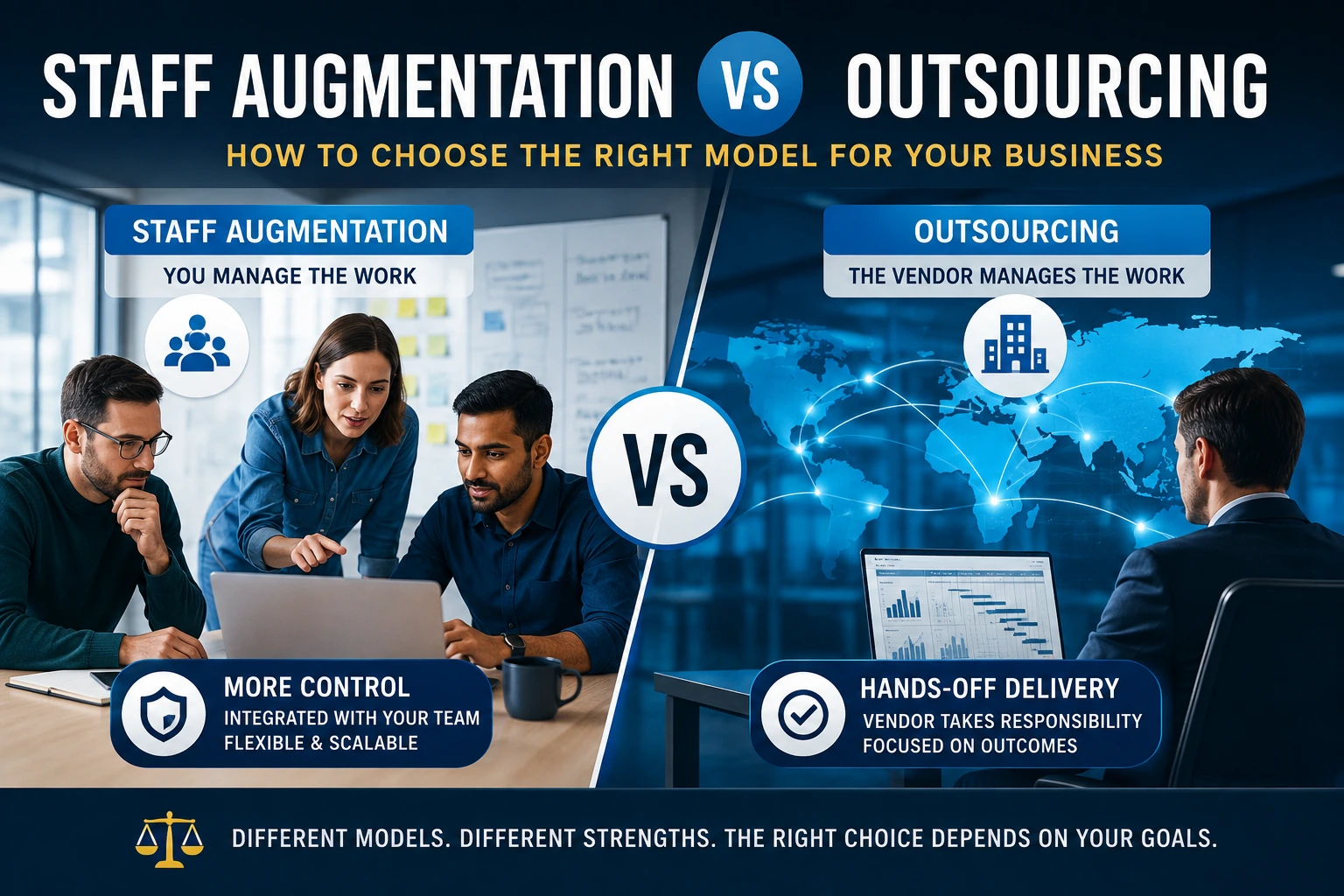
- Staff augmentation vs outsourcing comes down to one question: who manages the day-to-day work? In augmentation, you do. In outsourcing, the vendor does.
- Staff augmentation keeps control and institutional knowledge in-house; outsourcing shifts delivery risk and management overhead to the vendor.
- Deloitte's 2024 Global Outsourcing Survey (500+ executives globally) found 80% expected to maintain or increase their outsourcing investment — but that doesn't mean it's right for every project.
- Outsourcing tends to work best for well-defined, stable-scope projects; staff augmentation tends to work best for evolving, knowledge-heavy or core-product work.
- Many businesses use both at once — augmentation for the core product, outsourcing for peripheral or one-off functions.
Choosing between staff augmentation vs outsourcing is one of the more consequential calls a technical leader makes, and it's easy to get backwards. Pick outsourcing when your scope is stable and well-defined — you'll get hands-off delivery without paying for rework. Pick staff augmentation when requirements are likely to evolve and your team needs to retain day-to-day control — hand evolving work to an outsourced vendor and every reasonable change becomes a renegotiation. Neither model is universally better: Deloitte's 2024 Global Outsourcing Survey found 80% of executives expected to maintain or increase their outsourcing investment, which tells you outsourcing works well for plenty of businesses, just not all of them. This guide breaks down the real difference, the actual cost trade-offs, and a simple framework for choosing correctly.
What Is the Core Difference Between Staff Augmentation and Outsourcing?
Staff augmentation adds external specialists who work inside your team under your own management; outsourcing hands an entire project or function to a vendor who manages it independently and delivers an agreed outcome. In short: augmentation extends your team, outsourcing replaces the need to build one for that piece of work.
Every other difference — cost, risk, speed, who owns the code, what happens when the engagement ends — flows from that single distinction: who runs the work day to day.
Staff Augmentation vs Outsourcing: Side-by-Side Comparison
| Factor | Staff Augmentation | Outsourcing |
|---|---|---|
| Who manages the work | You | The vendor |
| Control over priorities | Full | Limited — set at contract level |
| Speed to start | Days to a few weeks | Depends on scoping and contracting time |
| Ideal scope type | Evolving, ongoing, or core product work | Well-defined, stable-scope projects |
| Management overhead for you | High — you direct the work | Low — vendor directs the work |
| Where knowledge lives | In-house | Largely with the vendor |
| Who's accountable for the outcome | You (they execute; you own results) | The vendor (contractually) |
What Is Staff Augmentation, Briefly?
Staff augmentation is hiring external specialists — developers, testers, DevOps engineers — who join your existing team, use your tools and processes, and report to your own technical leads, while a staffing partner handles their employment, payroll and compliance.
For a full breakdown of how the model works, pricing, and when to use it, see our companion guide: What Is Staff Augmentation?
What Is Outsourcing, Briefly?
Outsourcing is delegating an entire project, function or business process to an external provider, who takes full ownership of delivery — including staffing, project management, quality control and the final result — against an agreed scope and price.
The client defines what needs to be achieved; the outsourcing partner decides how. That single handover of "how" is what makes outsourcing fundamentally hands-off compared with staff augmentation.
Pros and Cons of Staff Augmentation
Pros
- Full control over priorities, code quality and day-to-day direction
- Faster ramp-up than a permanent hire — no lengthy recruitment cycle
- Fills a specific, niche skill gap without a permanent role
- Institutional knowledge stays with your team, not a vendor
- Easy to scale up or down as demand changes
Cons
- You carry the management overhead — someone internal has to direct the work
- Onboarding and culture fit take some ramp-up time, even for short engagements
- Not a good fit without internal technical leadership to guide contractors
- You still own the outcome, even when the individual contributor doesn't work out
Pros and Cons of Outsourcing
Pros
- Hands-off delivery — the vendor manages staffing, process and quality control
- Frees internal leadership to focus on strategic, differentiating work
- Can be more cost-predictable for a truly fixed, well-documented scope
- Vendor carries delivery risk and accountability for the agreed outcome
Cons
- Less day-to-day control over how the work gets done
- Scope changes typically mean renegotiating price and timeline, not just adjusting a backlog
- Knowledge of the system lives largely with the vendor, not your team
- Higher coordination risk if the vendor's processes don't match your standards
Which Costs Less: Staff Augmentation or Outsourcing?
Neither model is reliably cheaper in every situation — it depends on how stable the project scope is. Outsourcing can look cheaper upfront for a fixed, well-documented deliverable, while staff augmentation often works out more cost-effective on evolving work, because scope changes under an outsourced contract typically trigger renegotiation and rework costs.
Be sceptical of any comparison that quotes a precise universal percentage difference between the two models — genuine, verifiable figures at that level of specificity are hard to find, because so much depends on role, seniority, region, and how well-defined the work actually is.
What's better documented is the value case for getting sourcing strategy right in general: Bain & Company's research on outsourcing performance found that leaders who treat vendor relationships as long-term partnerships — rather than pure cost-cutting exercises — realise additional cost reductions of up to 25% on top of baseline savings. Deloitte's 2025 Global Business Services Survey similarly found that roughly 50% of responding organisations achieved savings above 20% from their sourcing arrangements — but the same survey notes that effective governance, not the model itself, was the key driver of that value. The lesson: cost outcomes depend far more on how well a model is managed than on which model you pick.
When comparing quotes directly, look beyond the headline rate. A staff augmentation rate card is usually simpler to compare like-for-like, since you're paying for hours or a dedicated resource. An outsourcing quote should be weighed against how the contract handles scope changes — ask specifically what happens, in dollar and time terms, if requirements shift by even 10–15% partway through delivery, since that's where an apparently cheaper outsourced quote can lose its advantage.
How to Decide: A Simple Decision Framework
Ask three questions: Is your internal team able to manage extra contributors day to day? Is the scope of work well-defined and unlikely to change significantly? Do you want your team to retain deep knowledge of this system long-term? Two or more "no" answers usually point toward outsourcing; two or more "yes" answers usually point toward staff augmentation.
- Do you have internal technical leadership with spare capacity to direct the work? If not, outsourcing reduces coordination risk.
- Is the scope genuinely fixed, or will it evolve as you learn more? Fixed, documented scope favours outsourcing; evolving scope favours augmentation.
- Does this work sit at the core of your product, or is it peripheral? Core, differentiating work usually benefits from staying in-house via augmentation; peripheral or one-off functions are safer to outsource.
- How fast do you need to start, and for how long? Short-term, specific skill gaps suit augmentation; larger, self-contained initiatives with a defined end suit outsourcing.
- Does long-term institutional knowledge matter for this work? If your team needs to maintain the system for years, augmentation keeps that knowledge in-house.
Can You Use Both Staff Augmentation and Outsourcing?
Yes — a growing number of organisations run a hybrid model: staff augmentation for core, evolving product work where control and institutional knowledge matter most, and outsourcing for well-defined, peripheral functions such as a one-off migration, a QA sprint, or a bounded feature module.
Common hybrid patterns include augmenting the core development team while outsourcing discrete, well-scoped modules; keeping architects and tech leads augmented for continuity while outsourcing specific project components; and maintaining a steady augmented baseline while outsourcing short, well-defined bursts of extra work during peak demand. This isn't indecision — it's matching each piece of work to the model that handles it best.
Staff Augmentation vs Outsourcing in Australia
Australia's persistent technology skills shortage makes both models relevant, but for different reasons: staff augmentation helps businesses access scarce specialist skills quickly without a lengthy local hire, while outsourcing helps stretched internal teams offload well-defined work entirely rather than compete for talent to do it in-house.
The Jobs and Skills Australia 2025 Occupation Shortage List confirmed 293 of 1,022 assessed occupations nationally — about 29% — remain in shortage. It's worth being precise here: general software engineer roles actually came off that list for the first time in 2025, while specific specialisations such as cyber security and software testing remain persistently short — so the shortage is concentrated, not broad. On the workforce-size side, the Tech Council of Australia set a goal in 2021 of growing the national tech workforce to one million by 2025, estimating the country would need roughly 286,000 additional workers to get there; by November 2025 the workforce had reached approximately 977,000 — a large gain, though just short of the original target. Although older Gartner research (a 2022 survey) found only 23.6% of Australia and New Zealand IT workers had high intent to stay with their current employer, it illustrates a retention pattern in the sector that's plausibly still relevant rather than a current 2026 figure — treat it as directional context, not a live statistic. Taken together, this points toward Australian businesses using both models deliberately: staff augmentation for the specific specialist gaps that remain genuinely scarce, and outsourcing or local hiring for the broader roles where the market has eased.
Signs You've Chosen the Wrong Model
Clear warning signs include an augmented team burning your internal leads' time faster than it saves it, an outsourced vendor repeatedly requesting change orders for what feels like normal iteration, or a team that can no longer explain how a system works because that knowledge sits entirely with an external party.
Signs staff augmentation isn't working
- Your technical leads spend more time managing the augmented specialist than they save in output
- The contractor is idle waiting on direction because nobody has clear ownership of their backlog
- You keep extending "short-term" engagements without ever building the internal capability the augmentation was meant to bridge toward
Signs outsourcing isn't working
- Every reasonable scope adjustment triggers a formal change order and a price renegotiation
- Your team can no longer maintain or meaningfully modify the delivered system without going back to the vendor
- Communication lag between your priorities and the vendor's execution keeps causing rework
If either pattern sounds familiar, it's usually cheaper to switch models on the next phase of work than to keep forcing the wrong one to fit.
What to Look for in a Partner That Offers Both Models
A partner capable of delivering both staff augmentation and outsourcing well should be transparent about which model fits your situation — even when one is less profitable for them — and should be able to show evidence of running its own production software, not just placing contractors or managing projects on paper.
- Will they recommend outsourcing over augmentation (or vice versa) even if it's a smaller engagement for them?
- Can they show a live product they've built and continue to operate themselves, demonstrating real delivery standards?
- Do they apply the same quality practices — code review, testing, documented processes — regardless of which model you choose?
- Are contract terms for IP ownership, replacement, and offboarding clear under both models, not just the one they'd prefer you pick?
Common Mistakes When Choosing Between the Two
The most common mistakes are choosing outsourcing for evolving, knowledge-heavy core product work (where scope drift erodes the cost advantage), choosing staff augmentation without any internal capacity to manage it, comparing headline rates without factoring in rework or coordination cost, and assuming the choice has to be all-or-nothing.
- Outsourcing core, evolving work. If requirements are likely to shift, an outsourced fixed-price contract usually means renegotiation, not flexibility.
- Augmenting without management bandwidth. If nobody has time to direct a new contributor, augmentation just adds coordination debt.
- Comparing rate cards, not total cost. A cheaper hourly rate can be erased by rework, delays or quality gaps further down the line.
- Treating it as binary. Most mature technology organisations use a mix, matched to each piece of work — not one model for everything.
A Real-World Example
The distinction is easiest to see in practice. Cognify Digital offers both staff augmentation and outsourced project delivery as separate engagement models specifically because the two solve different problems — a business building on its own product roadmap, like the Ausvanta NDIS compliance platform Cognify engineered for Neural Networks Group, needs a different resourcing approach for ongoing feature development than it does for a bounded, one-off piece of work such as a cloud migration or a security audit.
Not sure which model fits your current project? Cognify Digital's tech consulting and advisory team can map staff augmentation, outsourcing, or a hybrid approach to your roadmap, backed by our full-spectrum development services. Get a free solution outline to see what fits.
Frequently Asked Questions
What is the main difference between staff augmentation and outsourcing?
Staff augmentation adds people you manage yourself; outsourcing hands the entire project to a vendor who manages it and delivers a result.
Is staff augmentation cheaper than outsourcing?
Not reliably — it depends on scope stability. Outsourcing can look cheaper for fixed, well-defined work; staff augmentation often costs less overall on evolving work, where outsourced scope changes typically trigger rework and renegotiation.
Which is better for a startup: staff augmentation or outsourcing?
It depends on internal leadership capacity. A startup with strong technical leadership benefits from augmentation's control; a startup without spare management bandwidth often does better with outsourcing's hands-off delivery.
Can a business use both staff augmentation and outsourcing at once?
Yes, this hybrid approach is common — augmenting the core team for ongoing, evolving work while outsourcing well-defined, peripheral functions or one-off projects.
Who owns the code in staff augmentation vs outsourcing?
In staff augmentation, the client will often retain ownership of the work product, but ownership should be explicitly defined in the contract with the staffing provider. In outsourcing, ownership should also be clearly assigned in the contract, along with any rights relating to intellectual property, source code, and data.
Which model gives more control: staff augmentation or outsourcing?
Staff augmentation gives significantly more day-to-day control, since the client directs priorities, quality, and execution rather than a vendor.
Is outsourcing riskier than staff augmentation?
Outsourcing carries different risks, not necessarily more risk overall. It shifts more execution responsibility to the vendor but reduces the client's day-to-day control over how problems are handled.
How fast can each model start?
Staff augmentation specialists can typically start within days to a few weeks; outsourcing timelines depend more on scoping, vendor selection, and contracting than on sourcing individual people.
Does staff augmentation work well for short-term projects?
Yes, particularly for filling a specific, temporary skill gap — for example, a senior specialist needed for a few months ahead of a release.
What should I check before choosing an outsourcing vendor over staff augmentation?
Confirm how the vendor handles scope changes, who owns the resulting code and data, and what happens to institutional knowledge once the engagement ends.
Conclusion
Staff augmentation vs outsourcing isn't a question with one right answer — it's a question of who should run the work: you or the vendor. Choose staff augmentation when you have the internal leadership to direct contributors and the work is evolving or core to your product. Choose outsourcing when the scope is genuinely fixed and you'd rather hand off delivery entirely. And don't rule out doing both — many of the most effective technology organisations use staff augmentation for their core product and outsourcing for well-defined peripheral work, matching each model to what it actually does best.



0 Comments