

How to Add AI Engineers to Your Existing Product Team
Key Takeaways
- Adding AI engineers works best as a targeted move, not a department-wide hire. Start with one clear use case, not a general "do AI" mandate.
- Australian AI and machine learning engineers cost roughly $95,000 to $230,000+ in base salary depending on seniority and city, and the talent pool is genuinely tight.
- You have three practical paths in: hire permanently, bring in augmented specialists, or upskill engineers you already trust. Most teams end up mixing two of the three.
- The integration mistakes that cause the most damage happen after the hire, not before it. Isolation, unclear ownership and no evaluation process derail more AI hires than a weak candidate does.
- Only 12 per cent of Australian businesses reported using AI in their workplace in 2024–25, up from 1 per cent two years earlier. Most competitors have not solved this yet either.
Why this is a team design problem, not just a hiring problem
Your product roadmap has an AI feature on it. Maybe a smarter search, an assistant, a recommendation engine, some kind of automation. Someone has said the words "we need an AI engineer" in a planning meeting.
Here is the part that gets skipped. Adding one person with a different skill set to an existing team is not the same as adding another backend developer. The engineer arrives speaking a partly different language, working with partly different tools, and answering to a definition of "done" that does not look like a shipped feature.
Get the fit wrong and you end up with an expensive specialist bolted onto the side of the team, running prototypes nobody uses. Get it right and AI capability spreads through the whole team within a couple of quarters.
This guide covers the actual mechanics: what the role is, what it costs in Australia right now, the three ways to bring the capability in, and the specific integration steps that separate a hire that works from one that quietly fails.
What does an AI engineer actually do on a product team?
An AI engineer takes existing or pre-trained AI models and wires them into a working product — building the pipelines, APIs and evaluation checks that turn a model into a reliable feature. They sit closer to software engineering than to research.
That is a narrower job than most non-technical stakeholders picture. An AI engineer is not usually training a model from scratch. They are integrating one — often a large language model accessed through an API — into your product, handling the plumbing around it: retrieval pipelines, prompt management, evaluation, cost control and failure handling.
AI engineer vs machine learning engineer vs data scientist
These three titles get used almost interchangeably in Australian job ads, and that is part of why hiring goes wrong. They are different roles.
| Role | Primary focus | Typical output |
|---|---|---|
| AI engineer | Integrating AI models into products and pipelines | Working features: assistants, RAG systems, AI-powered workflows |
| Machine learning engineer | Building and deploying custom models end to end | Trained models in production, retraining pipelines |
| Data scientist | Experimentation, analysis, research | Insights, model prototypes, analysis reports |
Expert commentary: most product teams that need "an AI person" actually need an AI engineer, not a data scientist. The confusion between the two is one of the most common reasons a first AI hire underdelivers — the team hired for research skills when they needed product integration skills.
How much does it cost to add an AI engineer in Australia?
AI and machine learning engineer base salaries in Australia typically range from around $95,000 for a graduate to $230,000 or more for a senior specialist, before superannuation. Sydney and Melbourne sit at the top of the national range.
| Experience level | Typical base salary (AUD) | Notes |
|---|---|---|
| Graduate / junior (0–2 yrs) | $95,000 – $120,000 | Often paired with a senior engineer or tech lead |
| Mid-level (3–5 yrs) | $125,000 – $165,000 | Can usually own a feature end to end |
| Senior (6–9 yrs) | $155,000 – $200,000 | Sets technical direction, mentors others |
| Lead / principal / GenAI specialist | $195,000 – $230,000+ | Scarce; commands a premium for production LLM ownership |
These figures are drawn from published 2026 recruiter and salary-platform data and should be treated as market guidance, not a quote. Add roughly 12 per cent for superannuation, which the ATO confirms is the guaranteed rate from 1 July 2025, plus recruitment fees if you hire through an agency, plus onboarding time before the person is fully productive.
Why the talent pool is tighter than the salary numbers suggest
Money is not the only constraint. The ACS Australia’s Digital Pulse 2026 report, prepared by Deloitte Access Economics, found Australia’s technology workforce fell 0.3 per cent to around 967,000 workers in 2025 — the first recorded decline in twelve years of tracking. The same report estimates the country will need another 259,000 technology professionals by 2035.
At the same time, demand is climbing fast. ABS data on the 2024–25 Business Characteristics Survey found around 12 per cent of Australian businesses reported using AI in their workplace in 2024–25, up from just 1 per cent in 2022–23. Adoption was highest among large businesses, at 35 per cent, compared with 11 per cent for small and micro businesses.
Put those two facts together and the picture is clear. More businesses are chasing AI capability, from a technology workforce that just shrank for the first time on record. That scarcity is exactly why the "how do we get this skill into the team" question matters more than it did two years ago.
Three ways to add AI capability to your team
There is no single correct path. The right one depends on how permanent the need is, how fast you need it, and how much of your existing team can already stretch toward it.
Option 1: Hire a permanent AI engineer
This is the right call when AI is becoming a core, ongoing part of your product, not a single feature. A permanent hire builds deep product knowledge, sets standards for how AI gets used across the codebase, and is there when something breaks in production eighteen months from now.
The trade-off is time and risk. A specialist role in a tight market commonly takes ten to sixteen weeks from job ad to first contribution, and a bad permanent hire is expensive and awkward to reverse.
Option 2: Bring in an augmented AI specialist
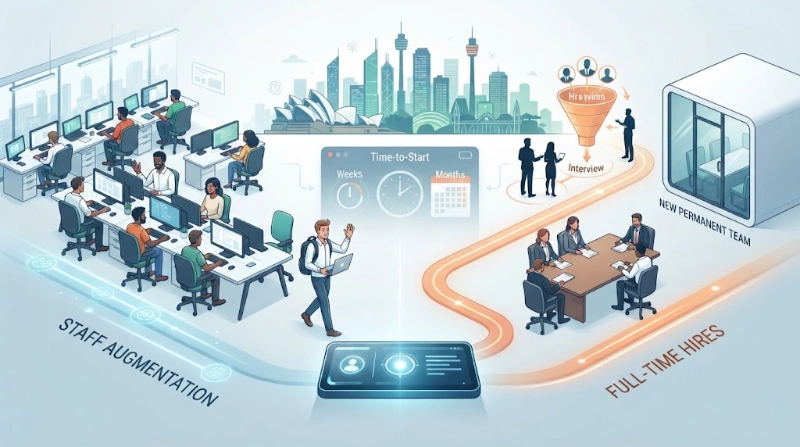
Staff augmentation adds an AI engineer to your existing team for an agreed period, working under your direction while a provider handles their employment. This is the fastest way to get capability into a team — often weeks rather than months — and it fits naturally when the need is a defined project, a proof of concept, or specialist skills you do not yet know if you need permanently.
The team keeps control of the work. What changes is speed to start and who carries the employment overhead.
Option 3: Upskill an engineer you already have
Sometimes the fastest and lowest-risk path is not hiring at all. A strong backend or data engineer already on your team, with product context and trust already built, can often pick up AI integration skills faster than a new specialist can pick up your codebase and domain.
This works best for well-scoped, API-based integrations — adding a chatbot, a document summariser, a recommendation feature. It works less well for anything requiring deep ML expertise, such as training custom models or running complex evaluation pipelines.
| Path | Speed | Best for |
|---|---|---|
| Permanent hire | Slow (10–16 weeks typical) | AI is core and ongoing to the product |
| Staff augmentation | Fast (2–6 weeks typical) | A defined project, a proof of concept, or a skills gap you are still sizing |
| Upskill in place | Fastest, but depends on the person | Well-scoped integrations, teams with strong existing engineers and product trust |
Most Australian teams that get this right end up mixing two of the three: upskilling one trusted engineer to lead the effort, then augmenting with a specialist for the harder integration work, before deciding whether a permanent hire is justified.
How to integrate an AI engineer into an existing team
This is the section most hiring guides skip, and it is where most of the actual risk sits. Getting someone signed is the easy part. Getting them productive inside a team with its own habits, review culture and roadmap is where hires succeed or quietly fail.
Step 1: Define one use case before you define the role
Do not hire for "AI capability" in the abstract. Pick the first thing you actually want built — a support assistant, a document processor, a recommendation feature — and hire or brief against that. A defined first project gives a new AI engineer something to ship in the first month, which builds trust with the rest of the team fast.
Step 2: Decide who they report to and who reviews their work
AI engineers often end up reporting into a structure built for traditional software work, where code review does not naturally cover model behaviour, prompt changes or evaluation results. Decide explicitly who reviews AI-specific decisions, even if that person is learning alongside the new hire.
Step 3: Set an evaluation process from day one
Traditional software either works or it does not. AI features are probabilistic — they can be right most of the time and wrong in ways that are hard to catch in a standard code review. Put a lightweight evaluation process in place before the first feature ships: a way to test outputs against real examples, track failure cases and catch regressions when the underlying model changes.
Step 4: Build in knowledge transfer, not just delivery
If the AI engineer is augmented or contracted rather than permanent, write knowledge transfer into the engagement from the start. Pair them with an existing engineer on the first project, document decisions as they are made, and record walkthroughs rather than leaving documentation for the final week.
Step 5: Give them the same access and visibility as everyone else
Splitting an AI engineer off into a separate tool, a separate standup or a separate Slack channel creates exactly the silo you are trying to avoid. Put them in the same repositories, same standups and same planning process as the rest of the team from week one.
Common mistakes when adding AI engineers to a team
Hiring for a title instead of a use case
A job ad for "AI Engineer" with no defined first project attracts generalists and produces vague outcomes. Write the ad, or the augmentation brief, around the actual feature you want built.
Treating AI work as exempt from code review
Because most of the team cannot evaluate a prompt or a model choice, AI work sometimes ships without the same scrutiny as everything else. That is backwards — it needs more structured review, not less, because failures are harder to spot.
Confusing a prototype with a production feature
A working demo of an AI feature and a production-ready one are different projects. Demos skip error handling, cost control and edge cases. Budget separately for the hardening work between prototype and ship.
Hiring a data scientist when you needed an AI engineer
As covered above, these are different skill sets. A strong data scientist can struggle to ship a production feature on a deadline, because that has never been the core of their job.
No plan for what happens if the model provider changes something
Products built on third-party LLM APIs are exposed to upstream changes in pricing, behaviour and availability. Before you ship, know who owns the response if the underlying model changes overnight.
Skipping the cost conversation until after launch
AI features that call external model APIs have a per-use cost that traditional software does not. Model that cost against expected usage before launch, not after the first invoice arrives.
A checklist before you add an AI engineer
- Do you have one clear, scoped use case for the first project?
- Do you know whether you need an AI engineer, a machine learning engineer, or a data scientist?
- Is the need permanent, project-based, or still being tested?
- Who will review AI-specific decisions, even informally, in the first few months?
- Do you have or can you build a basic evaluation process before launch?
- Have you budgeted for the ongoing per-use cost of any external AI model calls?
- Will the new hire or contractor sit inside your existing team structure, tools and standups?
If you cannot answer most of these yet, that is a sign to start with a feasibility conversation or a small augmented engagement before committing to a permanent hire.
Three situations, three different approaches
These scenarios are illustrative composites based on common patterns, not client case studies.
A Melbourne SaaS company adding an AI assistant feature
They had one clear use case — an in-app assistant answering questions from their own documentation — and a six-week deadline tied to a customer commitment. A permanent hire was too slow. They brought in an augmented AI engineer, paired with an existing backend developer, and shipped inside the deadline.
A Sydney fintech building AI into its core product
AI was not a single feature for them — it was becoming central to the product, powering risk scoring across the platform. That is a permanent, ongoing need. They hired a senior AI engineer directly and used a short augmentation engagement to keep other work moving during the search.
A regional services business testing one automation idea
They were not sure the idea would work, and were unwilling to commit permanent headcount to something that might get shelved. An existing developer with strong API integration experience picked up the first prototype using off-the-shelf tools, with light external advice on the parts that needed deeper expertise.
Questions to ask before you commit to a hire or engagement
- What is the first thing this person will ship, and by when?
- Is this an AI engineer, a machine learning engineer, or a data scientist role — and do we agree on the difference?
- Who reviews AI-specific work, and how confident are we in that review?
- What happens to the ongoing cost if usage of this feature grows tenfold?
- If this is augmentation, does the agreement cover IP assignment and knowledge transfer explicitly?
- What is our fallback if the underlying model provider changes pricing or behaviour?
So how should you actually add AI capability?
Start narrower than feels comfortable. Pick one use case, decide honestly whether the need is permanent or project-shaped, and choose the path — hire, augment, or upskill — that matches that answer rather than the one that sounds most impressive in a board update.
The businesses succeeding with this right now are not the ones with the biggest AI team. They are the ones who shipped one real feature, reviewed it properly, and used what they learned to decide what comes next.
Talk it through before you commit
If you are weighing up a permanent AI hire against bringing in specialist capacity for one project, it helps to talk through the actual use case first. Cognify Digital works with Australian product teams on AI and machine learning integration and can help you scope the first project, the right engagement model and the review process around it. Call 0468 167 862 or get in touch with the team to start the conversation. No obligation, and no push toward hiring over augmentation, or the other way around.
FAQ SECTION
What is the difference between an AI engineer and a machine learning engineer?
An AI engineer mainly integrates existing or pre-trained AI models into products, building the pipelines and evaluation around them. A machine learning engineer more often builds and deploys custom models end to end. The titles overlap in practice, so check what a role is actually being hired to do.
How much does an AI engineer cost in Australia?
Base salaries for AI and machine learning engineers in Australia typically range from around $95,000 for a graduate to $230,000 or more for a senior specialist, before superannuation. Sydney and Melbourne sit at the top end of the national range.
Should we hire an AI engineer permanently or use staff augmentation?
Hire permanently when AI is becoming a core, ongoing part of your product. Use staff augmentation when the need is a defined project, a proof of concept, or a skill set you are still sizing. Many teams use both, in sequence.
Can an existing developer become an AI engineer?
Yes, for well-scoped, API-based integrations such as adding a chatbot or document summariser. It works less well for anything requiring deep machine learning expertise, such as training custom models or building complex evaluation pipelines.
How long does it take to hire an AI engineer in Australia?
A permanent specialist hire commonly takes ten to sixteen weeks from job ad to first meaningful contribution, given a genuinely tight talent market. Staff augmentation typically takes two to six weeks.
What is the biggest mistake teams make when adding an AI engineer?
Hiring for a vague "AI capability" mandate instead of a defined first use case. A defined project gives the new hire something to ship early and builds trust with the rest of the team quickly.
Do AI features need a different review process than regular code?
Yes. AI outputs are probabilistic rather than deterministic, so a standard code review does not automatically catch bad model behaviour. Set up a lightweight evaluation process — testing outputs against real examples and tracking failure cases — before the first feature ships.
How many Australian businesses currently use AI?
The Australian Bureau of Statistics found around 12 per cent of Australian businesses reported using AI in their workplace in 2024–25, up from about 1 per cent in 2022–23. Adoption was much higher among large businesses, at 35 per cent, than small and micro businesses, at 11 per cent.
Is the AI talent shortage in Australia real?
The data points that way. The ACS Digital Pulse 2026 report found Australia’s technology workforce shrank by 0.3 per cent in 2025, the first recorded decline in twelve years of tracking, while AI adoption and demand for related skills continue to grow.
Can an AI engineer work alongside existing developers on the same codebase?
Yes, and this is generally the right setup. Keeping an AI engineer inside the same repositories, standups and review process as the rest of the team avoids the knowledge silo that forms when AI work is handled in isolation.
This article is general information only and is not legal, financial or employment advice. Salary bands, superannuation rates, technology workforce statistics and AI adoption figures vary over time and by source methodology. Figures cited were accurate at the time of writing and may since have been updated. Scenarios described are illustrative examples, not client case studies. Always confirm current requirements with the Australian Taxation Office, the Australian Bureau of Statistics, or a qualified adviser before making hiring or budget decisions.

0 Comments