
Key Takeaways
- Start with the business problem and a measurable outcome, not the tool.
- Buy where every competitor needs the same capability. Build where your data or process is the edge.
- Data control and Privacy Act duties can settle the decision before cost does.
- Integration and ownership costs usually outweigh the sticker price.
- Most businesses land on a hybrid: buy the commodity layer, build the part that is yours.
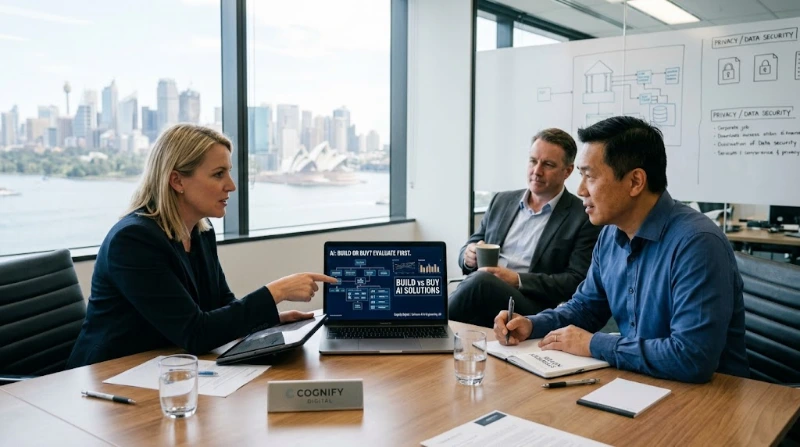
Build vs buy is rarely a clean either-or choice for AI. It is a spectrum, from a ready-made product you switch on this week to a custom application engineered around your data. Our AI and machine learning services in Australia team works through the order below before anyone signs a licence or writes a line of code.
The Short Answer
Buy a ready-made AI product when the task is common, the data is low-risk and a vendor already does it well. Build a custom AI application when the workflow is your competitive edge, the data is sensitive, or the tool must sit deep inside your systems. Many Australian businesses do both.
The Three Routes at a Glance
| Comparison | Ready-made product | Configured platform or API (hybrid) | Custom AI application |
|---|---|---|---|
| Speed to start | Fastest, often days | Weeks | Months, depending on scope |
| Fit to your process | You adapt to the tool | Partly shaped to your workflow | Built around your workflow |
| Data control | Set by vendor terms | Shared: you control the glue layer | Highest, if hosted in your environment |
| Integration effort | Light for standard tools, heavy for legacy systems | Medium | Highest upfront, designed to fit |
| Ownership | Subscription, no IP | Mixed | You can own code and workflows (agree IP in the contract) |
Swipe horizontally to compare all AI solution options.
Timings are typical ranges only. Scope, data quality and the systems involved move them a lot.
What to Evaluate First (In This Order)
1. The problem and how you will measure it
"We need AI" is the wrong starting point. "Cut quote turnaround from two days to two hours" is the right one. Without a measure, you cannot compare a product trial against a custom build on equal terms.
2. Whether the capability differentiates you
Ask a blunt question: if a competitor signed up to the same tool tomorrow, would it get the same benefit? If yes, buy. The NSW Government's buy, build or borrow guidance makes a similar point: build projects should contribute directly to core business, and custom solutions need ongoing investment in code, knowledge and infrastructure.
Expert commentary: Most invoice processing, meeting notes and generic chat support fall in the "buy" bucket. Building them rarely wins you a customer. Your pricing logic, your scheduling rules or your proprietary data are different. Those are worth protecting.
3. Data: where it lives, how clean it is, who can see it
This is the question most generic comparisons skip, and in Australia it matters early. The OAIC's guidance on privacy and commercially available AI products says privacy obligations apply to personal information put into an AI system, and to output that contains personal information. It also recommends that organisations avoid entering personal information into publicly available generative AI tools, and that they run a Privacy Impact Assessment as part of a privacy-by-design approach.
Before you buy, get written answers to these:
- Where is our data processed and stored?
- Is it used to train the vendor's models?
- How long is it retained, and can we delete it?
- Which subprocessors can touch it?
- Does any of this involve disclosing personal information overseas? (This can engage Australian Privacy Principle 8, so check with your legal adviser.)
A custom build can keep data inside your own cloud environment. That is a real advantage for health, finance, legal or government-adjacent work, but only if you also take on the security and monitoring that go with it.
4. Integration effort
A demo runs on clean sample data. Production runs on your CRM, ERP, email, identity provider and years of messy records. Integration is where "quick" products slow down and where custom builds earn their cost.
Ask each option:
- Is there a maintained connector for our core systems, or do we pay for middleware?
- Does it support single sign-on and role-based access?
- Does it produce audit logs we can show an auditor?
- What happens to our workflow when the vendor changes its API or pricing?
If the answers are weak, budget for custom software development or cloud and DevOps engineering to bridge the gap, whichever route you choose.
5. Total cost of ownership
Compare three-year costs, not first-month costs:
Three-year cost = set-up + licences or run costs + integration + people time + change or exit costs
| Cost line | Buying | Building |
|---|---|---|
| Up-front | Onboarding, configuration | Discovery, design, build, testing |
| Recurring | Per-seat or usage fees, add-ons | Hosting, model or API usage, monitoring |
| People | Admin, training, process change | Maintenance, evaluation, support |
| Risk | Price rises, lock-in, feature changes | Security patching, key-person dependency |
| Exit | Data export, retraining staff | Handover, documentation, code ownership |
AI coding tools have lowered the cost of writing software. They have not removed the cost of running it. In a Computing report on a Reddit discussion about replacing paid software with self-built tools, one security specialist called replacing business-critical systems with AI-generated code risky, because the builder then carries the operational and safety risk.
Expert commentary: A build quote is the start of the cost, not the end. Ask any vendor, including us, what year-two and year-three running costs look like in writing.
6. Governance and risk
Buying does not transfer accountability. The National AI Centre's Guidance for AI Adoption (October 2025) sets out six practices, including deciding who is accountable, measuring and managing risks, testing and monitoring, and maintaining human control. It also provides an AI screening tool, a policy template and an AI register template. These apply whether you build or buy. The difference is workload: with a purchased product you chase evidence from the vendor, and with a custom build you produce it yourself.
7. Your capability to run it
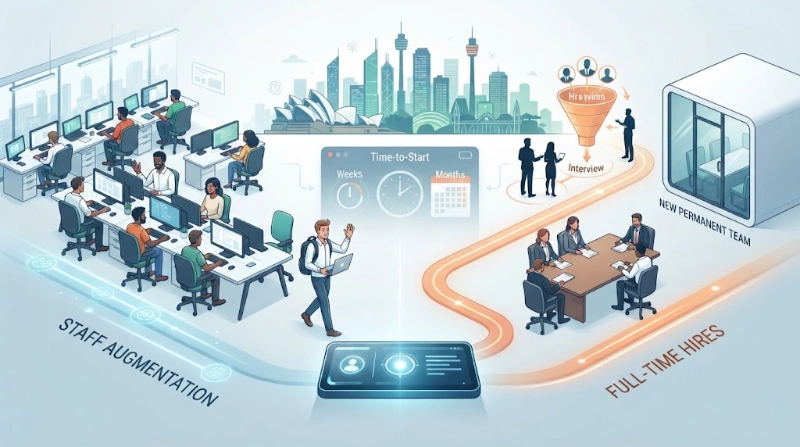
Models change, prompts drift and data shifts. Someone must own monitoring and improvement after launch. If you have no in-house engineers, a custom build needs a long-term support arrangement, or you need to add AI engineers to your product team through staff augmentation. Our guide to onshore, offshore and hybrid delivery in Australia covers that trade-off.
A Quick Decision Scorecard
- Lean buy if the task is common, the data is low-risk, you need results this quarter and your systems have standard connectors.
- Lean build if the workflow is a differentiator, data must stay in your environment, or the tool must fit tightly with legacy systems.
- Lean hybrid if a product covers most of the job but one step, such as scoring, routing or reporting, is specific to you.
If you are torn, our guide to custom AI solutions for Australian businesses explains what a custom build involves in practice.
Common Mistakes to Avoid
- Choosing from a demo. Test with your own messy data and your own users.
- Ignoring exit costs. Confirm you can export your data and prompts in a usable format.
- Building what you could rent. A cheap build still needs maintenance.
- Buying tool after tool. Overlapping pilots create sprawl and unclear ownership. If pilots have stalled, an AI rescue and optimisation review can show what to keep.
A Practical Path for Most Businesses
- Pick one workflow and write its success measure.
- Trial a ready-made product for a few weeks with real data.
- Record exactly where it falls short: accuracy, integration, privacy or fit.
- Build only the gaps, using AI workflow automation or AI product engineering where the gap is genuinely yours.
Not sure where generative AI fits first? Start with how generative AI and LLMs help your business, or talk to our tech consulting team.
Frequently Asked Questions
Is it cheaper to build or buy AI? Buying is usually cheaper to start. Building can cost less over time when you would otherwise pay for many seats or heavy usage, but only after maintenance, hosting and monitoring are counted.
How long does a custom AI solution take compared with a ready-made one? A ready-made product can often be running within days or weeks. A custom application usually takes months. Scope, data quality and integration complexity drive the difference.
Can we start with a product and build later? Yes, and it is often the safest route. Keep your data exportable, document where the product falls short, and only then commission the custom parts.
Are ChatGPT or Microsoft Copilot enough for a business? For general drafting and summarising, often yes, with the right enterprise settings. The OAIC recommends not entering personal information into publicly available generative AI tools, so set clear staff rules.
Do Australian privacy laws apply to AI products we buy? Yes. Privacy obligations apply to personal information you put into an AI system, whoever built it. Seek legal advice for your situation.
Who owns the IP in a custom AI build? It depends on your contract. Agree ownership of code, prompts, workflows and trained components in writing before work begins.
Talk to Cognify Digital
If you are deciding between a product and a custom build, we can review your use case, data and systems and give you a straight recommendation, even when that recommendation is to buy. Contact Cognify Digital to start the conversation, or explore our services.
Disclaimer: This article is provided for general informational purposes only and does not constitute formal legal, financial, or technical advice. Organisations should seek independent professional advice tailored to their specific regulatory, operational, and commercial circumstances before making AI adoption decisions.


0 Comments