

Key Takeaways
Staff augmentation makes sense when you have a clear, time-bound skills gap and want to keep control of the work in-house — not when the need is permanent, undefined, or better handed to a partner as a full outcome. The right call depends on the gap, the time horizon, your internal capacity to direct contractors, and the true cost against a dedicated team, outsourcing, or a direct hire. This guide gives you the framework to decide.
Every growing business eventually hits the same wall: a project needs skills the internal team doesn't have, and there's no time to run a three-month hiring process. That's the moment staff augmentation gets raised in the meeting — and the moment most teams get the decision wrong, either reaching for it out of habit or dismissing it without checking whether it actually fits. Choosing well here affects delivery speed, budget, and how much control you keep over the outcome. This guide sets out exactly when staff augmentation is the right call, when another model serves you better, and how to make that decision with a clear head rather than a deadline-driven gut call.
What Is Staff Augmentation, Briefly
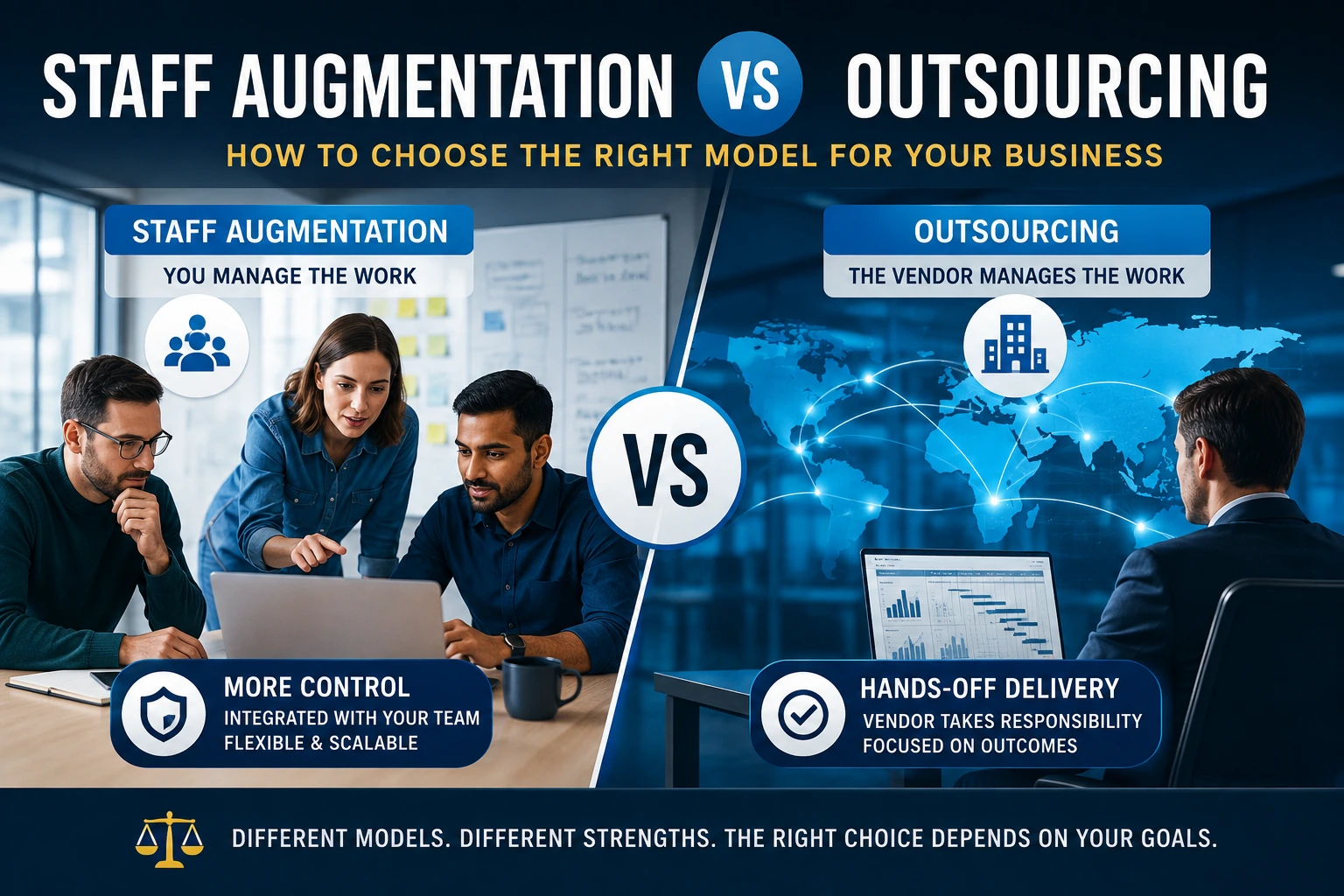
Staff augmentation is an engagement model where a business adds external specialists directly into its existing team, under its own management, to close a specific skills or capacity gap. Unlike outsourcing, the business retains day-to-day control and direction of the work; the augmented staff simply sit inside the team structure rather than delivering a finished outcome independently. For a full breakdown of how the model works, engagement types, and typical rates, see our companion guide to
what staff augmentation is and how it works, and how it differs from software outsourcing in practice.
The Real Question: When Does Staff Augmentation Make Sense?
Most articles answer this with a generic list of "benefits." The more useful question is what specific situation you're in right now. There are five recurring signals worth checking against.
1. You Have a Skills Gap, Not a Headcount Gap
If the problem is a missing skill — a Kubernetes migration, a compliance-heavy build, an LLM integration nobody on the team has shipped before — staff augmentation solves it directly by slotting in someone who already has that skill, rather than upskilling internally on the project's clock. If the problem is simply "we need more hands doing the same work everyone already knows how to do," a broader hiring or contracting decision may fit better.
2. The Work Is Time-Bound or Project-Based
A defined start and end — a product launch, a migration, a compliance deadline, a busy season — is the clearest signal. Staff augmentation lets you scale a team up for that window and back down once it closes, without the cost or complexity of a permanent hire you no longer need six months later.
3. You Need to Move Faster Than Your Hiring Pipeline Allows
Direct hiring in tech roles routinely takes eight to twelve weeks from job ad to start date, longer for niche or senior skills. Staff augmentation partners maintain vetted talent pools and can typically place a specialist within days to a couple of weeks — a meaningful difference when a deadline, contract, or funding milestone is already fixed.
4. You Want to Keep Control Without Keeping the Overhead
If your team should still run the architecture, code reviews, sprint planning and final decisions — but doesn't need another full-time salary, superannuation contribution and long-term commitment to get there — staff augmentation gives you that middle ground between a full-time hire and handing the whole thing to an outsourced vendor.
5. You're Testing a New Capability Before Committing to It
Adding an AI/ML specialist or a cloud engineer on an augmented basis lets a business validate whether it genuinely needs that capability long-term before creating a permanent role, a useful step before restructuring a team around a skill set that may only be needed occasionally.
Signals Staff Augmentation Is the Wrong Fit
It's just as important to recognise when the model doesn't fit. Reach for a different approach when:
- The function is core, ongoing and strategic — a permanent hire builds institutional knowledge an augmented contractor won't stay long enough to accumulate.
- Your internal team has no spare capacity to manage, brief or review the augmented specialist's work — augmentation still requires direction; it isn't a hands-off outcome.
- You want a fixed price for a fully defined outcome and no involvement in day-to-day delivery — a project-based or outsourced engagement transfers that risk more cleanly.
- The engagement will genuinely run for years with no defined end — at that point, direct hiring is usually more cost-effective than ongoing contractor rates.
Staff Augmentation vs Other Engagement Models
The decision rarely sits between "staff augmentation" and "do nothing" — it sits between staff augmentation and three other models. Here's how they actually compare:
| Model | Who directs the work | Speed to start | Cost structure | Best for |
|---|---|---|---|---|
| Staff augmentation | Your team, day to day | Days to a few weeks | Contractor rate; no long-term commitment | A defined skills or capacity gap inside an existing team |
| Outsourcing | The vendor, against a scope | Weeks (scoping first) | Fixed price or milestone-based | A whole function or project you don't need to run yourself |
| Dedicated team | Shared, vendor-supported | Weeks | Ongoing team rate | Long-running products needing a stable, embedded team |
| Direct hiring | Your team, permanently | 8–12+ weeks typically | Salary, super, leave, overhead | Core, permanent, ongoing capability |
What the Data Says About Australia's Talent Market
The case for staff augmentation in Australia isn't theoretical — it follows from the shape of the local labour market. Australia's technology workforce actually shrank for the first time on record in 2025, down 0.3% to around 967,000 workers according to the Australian Computer Society's Digital Pulse report, drawn from Australian Bureau of Statistics data — even as demand for AI, cybersecurity and cloud skills keeps climbing.
A few figures worth having in the room when the "should we hire or augment" conversation comes up:
- Software engineering roles have eased in some markets, but AI, cybersecurity and cloud specialists remain in acute shortage nationally.
- A significant share of Australian employers already source technology talent internationally to fill roles they can't fill locally.
- The global IT staff augmentation market was valued at roughly USD 299 billion in 2024 and is projected to grow at a double-digit compound annual rate through the early 2030s, reflecting how mainstream the model has become for exactly this kind of gap.
None of this means staff augmentation is always the answer — but it explains why waiting for a perfect internal hire on a fixed deadline is an increasingly expensive bet.
Why the People Decision Matters as Much as the Model
Whichever model you choose, the underlying stakes are the same. As Richard Branson put it: “There is nothing more important for a business than hiring the right team.” Former GE COO Lawrence Bossidy made a similar point more bluntly: “Nothing we do is more important than hiring people.” Staff augmentation doesn't lower the stakes of that decision — it just changes the mechanism by which you act on it quickly.
A Practical Decision Framework
Run any project or gap through these five steps before choosing an engagement model.
Step 1: Define the Gap Precisely
Write down the exact skill or capacity missing — not "we need more developers" but "we need someone who has shipped a production RAG pipeline" or "we need a second QA automation engineer for eight weeks." Vague gaps lead to the wrong hiring decision regardless of model.
Step 2: Estimate the Time Horizon
Under three to six months and clearly bounded — staff augmentation or a project-based engagement fits well. Open-ended and core to the business — lean toward direct hiring or a dedicated team.
Step 3: Check Your Internal Capacity to Direct the Work
Staff augmentation only works if someone on your team can brief, review and manage the augmented specialist. If that capacity doesn't exist either, outsourcing the whole outcome is usually the safer choice.
Step 4: Compare the True Cost, Not Just the Rate
A contractor's hourly or day rate will usually look higher than an equivalent salary on paper. Compare it against the fully loaded cost of a permanent hire — recruitment fees, superannuation, leave entitlements, onboarding time and the cost of a bad long-term hire — before assuming augmentation is the expensive option.
Step 5: Choose the Model, Then the Partner
Once the model is clear, choose a partner based on how they vet, onboard and manage augmented staff — not just on rate. A partner who slots specialists in without any handover process shifts all the management burden back onto you.
Common Mistakes Businesses Make With Staff Augmentation
- Treating it as outsourcing and expecting a hands-off outcome, then being surprised the internal team still needs to manage delivery.
- Bringing in augmented staff for core, permanent functions instead of defined, time-bound gaps — then re-running the same expensive search a year later.
- Skipping onboarding because the engagement feels "temporary," which slows the specialist down and undermines the speed advantage augmentation is meant to provide.
- Misclassifying the arrangement — Australian businesses need to get the contractor-versus-employee distinction right, since incorrectly engaging someone as a contractor can trigger sham contracting penalties under the Fair Work Act.
- Choosing the cheapest rate over a partner with a genuine vetting and quality process, then absorbing the cost of rework later.
Where Staff Augmentation Works Well in Australia
Software and product companies scaling a sprint
A product team with a fixed launch date and a gap in mobile, QA automation or DevOps commonly augments for the sprint rather than hiring permanently for a spike in demand.
Regulated sectors like healthcare and NDIS compliance software
Compliance-heavy builds — rostering, incident management, audit evidence — often need niche skills (secure cloud architecture, specific integrations) for a defined build phase, then settle into a smaller ongoing maintenance team.
Fintech and e-commerce during peak demand
Payment integrations, checkout performance work, and seasonal traffic spikes are classic time-bound gaps augmentation is built for.
A Real-World Example
Staff augmentation isn't only a small-business tactic. Pharmaceutical company Merck & Co. has used staff augmentation contracts across its multi-country capital projects program — filling roles such as contract administrators, quality control inspectors and construction auditors on a forward-planned basis to keep core delivery on track without permanently expanding headcount for project-specific roles.
What This Means for Your Business
If your gap sits in AI and machine learning — an LLM feature, a RAG assistant, a predictive model — augmenting with specialists who've shipped that work before is usually faster than growing the skill internally; see how Cognify's AI and machine learning team approaches this. The same logic applies to
cloud and DevOps engineering gaps — migrations, CI/CD pipelines, infrastructure-as-code — where a specialist can slot in and be productive inside your existing sprint cycle within days. And if you're still weighing which engagement model fits your specific project,
the Cognify Digital team can map the gap, the timeline and the right model against your budget before you commit to either a hire or a contract.
Frequently Asked Questions
What is staff augmentation in simple terms?
Staff augmentation is adding external specialists directly into an existing team, under that business's own management, to fill a specific skills or capacity gap without a permanent hire.
When should a business choose staff augmentation over outsourcing?
Choose staff augmentation when you want to keep control of the work and direction in-house; choose outsourcing when you want a vendor to own the full outcome against a fixed scope.
How quickly can a business start with staff augmentation?
Vetted specialists can typically start within days to a couple of weeks, compared with eight to twelve weeks or more for a direct hire in a competitive skills market.
Is staff augmentation cheaper than hiring a full-time employee?
It depends on the time horizon. For short, defined engagements it's usually cheaper once recruitment costs, superannuation, leave and onboarding are factored in; for multi-year needs, direct hiring is often more cost-effective.
Can staff augmentation cover AI and machine learning roles?
Yes — AI/ML is one of the most common uses, since niche skills like LLM integration or RAG pipeline development are scarce and often only needed for a defined build phase.
What's the difference between staff augmentation and a dedicated team?
Staff augmentation adds individuals into your existing team structure; a dedicated team is a separate, vendor-supported unit working exclusively on your product, typically for longer-running engagements.
Does staff augmentation work for small businesses?
Yes — it's often more accessible for small businesses than a dedicated team or large outsourcing contract, since it can scale to a single specialist for a single defined gap.
What are the risks of staff augmentation?
The main risks are treating it as a hands-off outcome, skipping onboarding, and misclassifying the engagement under Australian workplace law — all avoidable with a clear scope and a properly structured contract.
How does a business avoid contractor misclassification risk?
By correctly structuring the engagement as a genuine contractor arrangement rather than disguising an employment relationship — the Fair Work Ombudsman's guidance sets out the tests used to tell the two apart.
Should a startup use staff augmentation before its first full-time hire?
Often yes — it lets a founder validate exactly what skill set is needed and how the team should be structured before committing to a permanent role and salary.
Ready to Scale Your Team with the Right Talent?
Get clear guidance on whether staff augmentation fits your project timeline, skills gap, and budget.

0 Comments