

Key Takeaways
- Custom software development cost in Australia depends on scope, not a flat rate. Agency guides published in 2026 range from about $15,000 for a focused tool to $250,000 or more for complex platforms.
- Seven factors set most budgets: features, integrations, compliance, platform, team model, design and testing, and running costs.
- Plan for upkeep. Agency guides often suggest budgeting roughly 15–25% of the build cost each year.
- Some projects may qualify for the R&D Tax Incentive. However, routine development usually does not.
Most Australian businesses ask the same first question about a software build: how much will it cost? Honestly, the answer is "it depends". Custom software development cost in Australia moves with scope, integrations, compliance needs and the team you choose. That makes headline prices hard to compare. This guide explains what sets the budget, what quotes often leave out, and how to compare proposals fairly. If you are still scoping, our custom software development services team can pressure-test your brief before you commit.
How Much Does Custom Software Cost in Australia?
Published Australian agency guides in 2026 put custom software anywhere from about $15,000 for a focused internal tool to $250,000 or more for complex platforms. Those ranges are market signals, not quotes. Your price depends on scope, integrations, compliance and team model. A written scope is the only reliable basis for a number.
Why is the spread so wide? Because "custom software" covers everything from a simple workflow tool to a multi-user platform with payments and reporting. As a result, two quotes for the "same" product can differ by tens of thousands of dollars. Often, the gap sits in what each quote includes. Treat every figure you read online, including these, as a starting point.
What Determines Custom Software Cost? Seven Factors
1. Scope and feature count
Every feature adds design, build, testing and maintenance time. Therefore, the fastest way to control cost is to cut features, not rates. Start with the one workflow that creates value. For example, a booking tool with sign-in and payments costs far less than one that also adds roles, reporting and integrations. Add the rest after launch.
2. Integrations
Connecting to accounting, CRM, payroll or government systems often takes more effort than the screens users see. Each integration needs mapping, testing and error handling. In addition, some third-party APIs charge usage fees. Ask your provider to list and price every integration separately.
3. Compliance and data handling
Regulated data raises the bar. Health, finance and disability services need stricter security, audit trails and access controls. Also, Australian Privacy Principle 8 makes your business accountable when personal information is disclosed overseas. That can shape your hosting choices and offshore access. For a sector where compliance drives the build, see our page on software development for NDIS and care providers.
4. Platform and complexity
A web app, a mobile app and an AI feature each carry different effort. Mobile builds usually need platform-specific work and app store compliance, so they often cost more than a comparable web app. Explore our mobile app development approach for details. AI features add data preparation and ongoing tuning. Our guide to custom AI solutions explains what that involves.
5. Team model and location
Who builds the software matters as much as what you build. An in-house hire carries salary plus on-costs, such as the 12% Superannuation Guarantee. An agency bundles those costs into its rate. Staff augmentation sits between the two. Meanwhile, offshore teams can lower hourly rates but add communication and compliance overhead. Our staff augmentation checklist shows how to compare these models.
6. Design, testing and quality
Cutting design and quality assurance saves money early and costs more later. Usability problems and bugs found after launch need rework. So, budget for UX design, automated testing and security checks inside the build, not after it.
7. Hosting, maintenance and support
Launch is the start of spending, not the end. Software needs hosting, patching, monitoring and new features. Agency guides commonly suggest budgeting around 15–25% of build cost per year. That figure is a rule of thumb, not a government benchmark. Therefore, ask for a written support estimate before you sign.
What Do Quotes Often Leave Out?
Compare line items, not totals. First, check whether each quote covers:
- Discovery and scoping workshops
- A testing and bug-fix period after launch
- Hosting and cloud fees
- Third-party licences and API usage fees
- Security testing
- Data migration and user training
- GST (confirm whether prices include it)
Fixed Price, Time and Materials or Dedicated Team?
The pricing model changes who carries the risk. Here is how the three common options compare.
| Model | How you pay | Works best when | Watch out for |
|---|---|---|---|
| Fixed price | One agreed price for a defined scope | Scope is clear and stable | Change requests add cost, and the price may include a risk margin |
| Time and materials | Hourly or daily rates for work done | Scope will evolve as you learn | Budgets can drift without caps and regular reporting |
| Dedicated team or staff augmentation | Monthly rate per person | You manage the work and need capacity | Needs your time to direct and onboard people |
Can You Offset the Cost? The R&D Tax Incentive
Some software projects may qualify for the R&D Tax Incentive. According to the ATO's R&D offset rates guidance, eligible entities with aggregated turnover under $20 million can access a refundable offset equal to the company tax rate plus an 18.5% premium.
However, eligibility depends on the work, not the industry. Routine development usually does not qualify. Experimental work that tackles genuine technical uncertainty may. Read the business.gov.au R&D Tax Incentive guidance and speak to a registered adviser before you plan your budget around it.
How to Compare Quotes Fairly
- Give every provider the same written brief.
- Ask for line items: discovery, design, build, testing, hosting and support.
- Check what the price assumes about scope changes.
- Confirm in writing that you own the intellectual property.
- Ask who is accountable for data hosting and security.
- Compare three-year cost, not only the build price.
When Is Custom Software Not Worth the Cost?
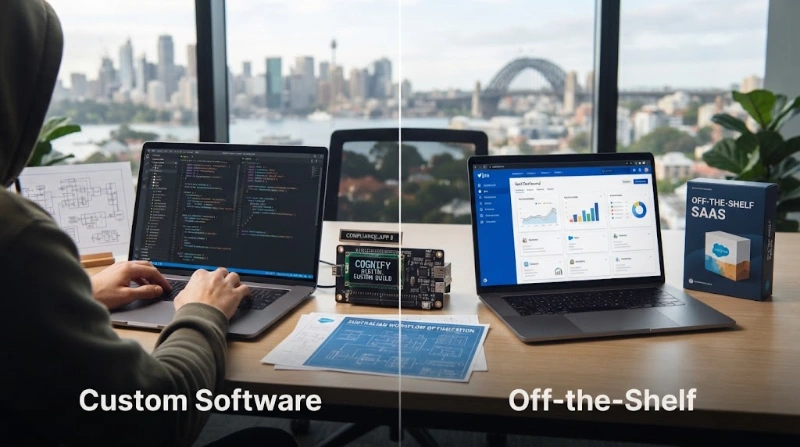
Custom software is not always the right move. If your workflow is standard, an existing tool may serve you well. Likewise, software rarely fixes a process nobody has defined. For a three-year view of both paths, read our guide to custom software vs off-the-shelf.
Talk Through Your Budget
If you want a second opinion on scope or budget, get in touch or call 0468 167 862. You can also browse what we have built or visit Cognify Digital to see how we work.
Frequently Asked Questions
How much does custom software development cost in Australia?
Published agency guides range from about $15,000 to $250,000 or more. Scope drives the number, so only a written scope produces a reliable quote.
Why do software quotes differ so much?
Quotes differ because of scope, integrations, compliance needs, team model and what each quote includes. Always compare line items.
Is custom software cheaper than off-the-shelf software?
Usually not upfront. Over several years, the answer depends on subscription growth, add-on costs and how long you will run the system.
How much should I budget for maintenance?
Agency guides commonly suggest roughly 15–25% of the build cost per year. Confirm the figure with a written support estimate.
Do offshore teams cost less?
Hourly rates are often lower. However, management, time zones and data compliance can add overhead, so compare total cost.
Should I choose fixed price or time and materials?
Fixed price suits a clear, stable scope. Time and materials suits work that will evolve as you learn.
Can the R&D Tax Incentive reduce my software cost?
It may, if the work involves genuine experimental activity. Routine development usually does not qualify, so check eligibility on business.gov.au and with a registered adviser.
How long does a custom software project take?
It depends on scope. A focused first release commonly takes a few months rather than weeks.
Will I own the code?
That depends on your contract. Confirm intellectual property assignment in writing before work starts.
What is the cheapest way to start?
Build a focused MVP around one core workflow. Then expand based on real user feedback.
Disclaimer
Prices, tax offsets, compliance duties and eligibility rules can vary by state and provider, and may change with updated policies. Figures from agency guides are market signals, not quotes. Confirm current details with the ATO, business.gov.au, the OAIC and a qualified adviser before you make budget decisions.

0 Comments