

Most Australian businesses ask one question first: how much does custom AI cost? The honest answer is that it depends on what you build. A simple chatbot costs far less than a secure assistant connected to your documents and systems. If you are weighing a project, our AI and machine learning development services show what we build.
Key takeaways
- Most custom AI projects fall between $10,000 and $150,000 AUD. Enterprise systems cost more.
- Data quality and system integrations usually drive cost more than the AI model itself.
- Running costs, such as API usage, hosting and maintenance, continue after launch.
- Only genuine experimental R&D may qualify for the R&D Tax Incentive. Routine builds often do not.
How much does custom AI development cost in Australia?
Cost depends on scope, not on the “AI” label. Two businesses can ask for an AI assistant and receive very different quotes. One wants answers to ten common questions. The other wants answers drawn from thousands of internal documents, with staff permissions and CRM updates.
Use the ranges below as a starting point for planning.
| Solution type | Indicative cost (AUD) | What you typically get |
|---|---|---|
| Basic custom FAQ chatbot | $10,000–$30,000 | Answers predefined questions on your site |
| Knowledge chatbot or RAG pilot | $25,000–$50,000 | Answers from a limited set of your documents |
| Production RAG assistant | $60,000–$150,000 | Secure, tested assistant with permissions and citations |
| AI workflow automation (one process) | $30,000–$90,000 | AI-assisted process connected to your systems |
| Integrated AI agent or enterprise system | $80,000–$250,000+ | Actions across several systems, with monitoring |
These are indicative planning ranges based on published agency estimates and common project scopes. They exclude GST. They are not Cognify Digital quotes, and no official Australian industry average exists. Always compare what each quote includes, not just the total.
What does an AI development budget include?
The model is only one part of the work. A professional project usually covers:
- Discovery and business requirements.
- Solution architecture and design.
- Data collection and preparation.
- Model selection and integration.
- Application development and testing.
- Security, deployment and handover.
- Monitoring and ongoing maintenance.
Data preparation and system integration often take more effort than the AI itself.
What makes an AI chatbot expensive?
Capability makes the biggest difference. A basic chatbot answers questions about opening hours and services. A more advanced one can:
- Understand natural-language questions.
- Retrieve answers from company documents.
- Check customer details through an API.
- Create support tickets and update CRM records.
- Hand complex enquiries to a staff member.
Each extra capability needs development, security review and testing. For example, connecting a chatbot to your CRM requires authentication, API work and permission controls. Therefore, define the chatbot’s responsibilities before you request quotes.
Why does RAG cost more than a basic chatbot?
RAG stands for retrieval-augmented generation. The system finds relevant information in your approved data, then gives it to an AI model to write the answer. That retrieval layer is where most of the extra cost sits.
A typical RAG project includes:
- Document collection: gathering PDFs, manuals, policies and records.
- Data preparation: cleaning files, removing duplicates and fixing formats.
- Chunking: splitting content into searchable sections.
- Embeddings and a vector database: storing content so the system can find it fast.
- Access permissions: making sure staff only retrieve what they may see.
- Evaluation: testing accuracy, relevance and source citations.
Document condition matters a lot. Clean digital files are quick to process. Inconsistent documents and scanned records take longer. As a result, a messy document library can raise the budget noticeably.
How much does AI workflow automation cost?
Cost depends on the number of processes, integrations and approval steps. Consider an accounts team that processes supplier invoices. A custom workflow might read each invoice, extract supplier details and amounts, check required fields, match it to a purchase order, send exceptions for human approval, and pass approved data to the accounting system.
The cost rises when the workflow must handle many invoice formats, older software or complex approval rules. Connecting to accounting, CRM, ERP or ticketing tools can cost more than configuring the model.
Our advice: automate one high-volume, measurable process first. Expand after you have tested accuracy and business value.
Which factors affect custom AI development cost?
- Data quality: poor data increases preparation time and hurts accuracy.
- Model choice: harder reasoning tasks need more capable, costlier models. Simpler tasks often work with smaller ones.
- Integrations: legacy systems add engineering work.
- Security and privacy: sensitive data needs access controls, encryption and audit logs.
- Testing: AI output is not always correct, so you need test datasets and failure handling.
- Scale: a customer-facing platform needs more infrastructure than a small internal tool.
What does it cost to run an AI system?
Development does not end at launch. Plan for this formula:
Total cost of ownership = development + API usage + infrastructure + maintenance + monitoring + future improvements
| Running cost | What you pay for |
|---|---|
| LLM API | Input and output tokens |
| Embeddings | Processing new documents and queries |
| Vector database | Index storage and retrieval |
| Cloud hosting | Servers, databases and networking |
| Monitoring | Logs, error tracking and performance checks |
| Maintenance and security | Updates, fixes and access reviews |
We can help you plan hosting through our cloud and DevOps services.
How do AI token costs work?
Most hosted language models charge by usage. Input tokens are the text you send to the model. Output tokens are the text it generates.
Here is an illustrative example. Your chatbot handles 10,000 conversations a month. Each conversation uses 1,500 input tokens and 500 output tokens. That gives you 15 million input tokens and 5 million output tokens a month.
Assume hypothetical rates of $3 per million input tokens and $15 per million output tokens. The monthly model cost would be (15 × $3) + (5 × $15) = $120. These rates are examples only. Check current prices on provider pages such as OpenAI API pricing and Anthropic’s pricing documentation. Hosting, storage and other services cost extra.
How can you control running costs?
- Match the model to the task’s complexity.
- Limit unnecessary conversation history.
- Use prompt caching where the provider supports it.
- Monitor token use, and set usage limits and alerts.
- Review hosting and database needs regularly.
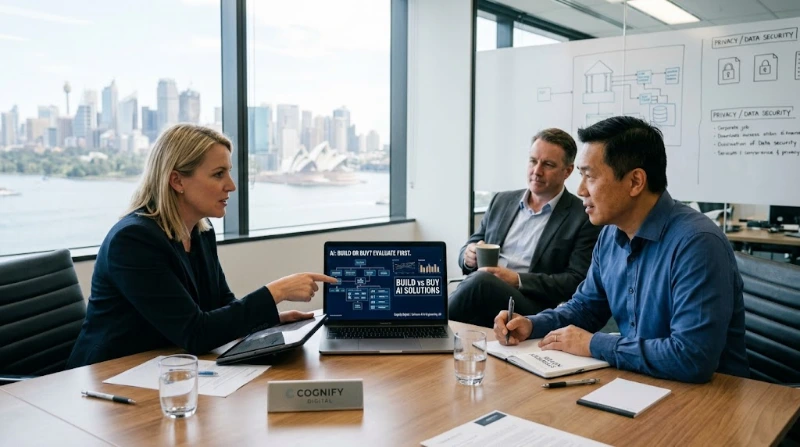
Should you build custom AI or buy an existing tool?
Buy when your needs are standard. Build when your data, processes or integrations need more control.
| Requirement | Existing AI platform | Custom AI solution |
|---|---|---|
| Standard FAQ chatbot | Usually suitable | Often unnecessary |
| Basic content assistance | Usually suitable | Often unnecessary |
| Private company knowledge | Depends on the platform | More design control |
| Complex workflow automation | May hit limits | More flexibility |
| Proprietary processes and integrations | Limited customisation | Built around your requirements |
Start with the business problem, not the technology. Our guide to build vs buy AI solutions walks through what to evaluate first. If your needs go beyond AI, see our custom software development services. For a broader view of software budgets, read what drives custom software cost in Australia.
Can AI development qualify for the R&D Tax Incentive?
Potentially, but ordinary software development does not qualify automatically. The key test is technical uncertainty. Eligible core R&D activities must test a hypothesis whose outcome you cannot know in advance, and they must follow a systematic experimental process.
For example, a team might find that existing retrieval methods cannot reliably search a complex dataset. It then forms a hypothesis, tests alternative methods and records the results. That kind of work may qualify if it meets the legislative requirements. Simply connecting an existing language model to your website is unlikely to qualify.
For companies with aggregated turnover under $20 million, the refundable offset is the company tax rate plus an 18.5% premium, according to the ATO’s rates page. You must register your activities with the Department of Industry, Science and Resources within 10 months of the end of your income year. Registration is not verification of eligibility, so the ATO can still review your claim. The business.gov.au R&D Tax Incentive overview explains the process.
Get specialist tax advice before you claim. Never assume your whole AI invoice qualifies. Rules and rates can also change.
What privacy and security issues should you plan for?
AI systems can handle customer records, staff data and confidential documents. The Office of the Australian Information Commissioner (OAIC) says organisations should do due diligence before adopting an AI product. It also recommends a privacy by design approach, including a privacy impact assessment, and advises against entering personal information into publicly available generative AI tools. Read the OAIC guidance on commercially available AI products.
On security, the Australian Cyber Security Centre’s Engaging with Artificial Intelligence guidance recommends applying its advice alongside the Essential Eight. For governance basics, the National AI Centre’s essential AI practices are a useful start.
Before development begins, agree on:
- Where data is stored and processed.
- What access the model provider has.
- User authentication and permissions.
- Data retention and deletion.
- Encryption, audit logging and human review of important decisions.
What should you ask before hiring an AI development company?
A low quote is not always the best value. Compare deliverables, ownership and ongoing responsibilities. Ask each partner:
- What does the quote include and exclude?
- Who owns the source code and intellectual property?
- Which model and cloud infrastructure will you use?
- How will you protect our private data?
- What testing happens before launch?
- Are API and hosting costs included?
- Who handles maintenance and improvements?
- Can the solution scale as we grow?
Also ask for a milestone-based breakdown. If you need extra engineering capacity during the build, consider our staff augmentation services.
Start with a clear scope
Choose the problem first, then the technology. Identify the process you want to improve. Then assess your data, integrations, security needs and expected usage. A focused proof of concept lets you test value before you commit to a larger budget.
Cognify Digital helps Australian businesses with custom AI, machine learning, LLM integration and workflow automation. If you want help scoping a project, see our technology consulting or discuss your AI development project with the team. You can also explore the rest of Cognify Digital.
Frequently asked questions
How much does custom AI development cost in Australia?
Most projects fall between $10,000 and $150,000 AUD, depending on scope. Simple chatbots sit at the low end. Integrated agents and enterprise systems can exceed $250,000.
How much does an AI chatbot cost in Australia?
A basic custom FAQ chatbot may cost $10,000–$30,000. Knowledge chatbots that use your documents usually cost more, and agents that act across systems cost more again.
How much does RAG development cost?
A RAG pilot may cost $25,000–$50,000. Production systems with permissions and testing commonly cost $60,000–$150,000.
How much does AI workflow automation cost?
An AI-assisted workflow for one process may cost $30,000–$90,000. Complexity, integrations and approval rules move the price.
What is the difference between RAG and a chatbot?
A chatbot is a conversational interface. RAG adds a retrieval layer that pulls relevant information from your data before the model answers.
What are the monthly costs of running an AI application?
Expect API tokens, hosting, databases, storage, monitoring and maintenance. Actual costs depend on usage and infrastructure.
Does custom AI require training a new model?
Not usually. Many custom applications use existing models through APIs. Fine-tuning only makes sense for specific requirements.
Can small businesses afford custom AI?
Often, yes. A focused proof of concept or a single automated workflow keeps the initial investment manageable.
Can AI development qualify for the R&D Tax Incentive?
Potentially. Only eligible experimental activities qualify, and routine implementation does not automatically count. Seek specialist advice before you claim.
How long does custom AI development take?
A proof of concept may take several weeks. Production systems often take several months, depending on integrations, data preparation and testing.
Disclaimer: All prices are indicative estimates in Australian dollars, excluding GST, and vary by provider and scope. Tax incentives, regulations and privacy requirements change over time. Seek professional technical, legal and tax advice before making investment or compliance decisions.


0 Comments