
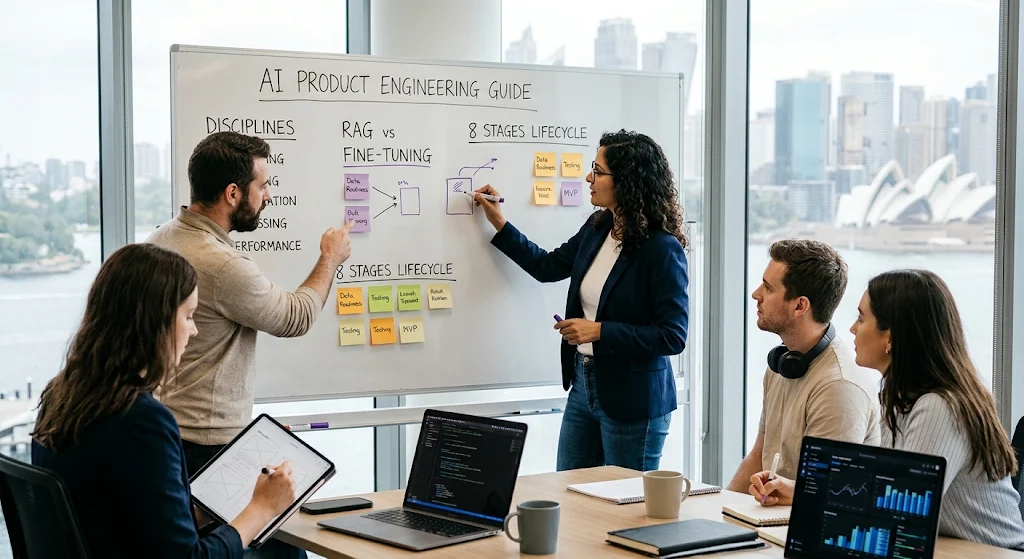
Key Takeaways
- AI product engineering combines software development, machine learning, data engineering and product design to build intelligent software products.
- Start with a business problem, not a technology. AI is not always the most practical solution.
- Data readiness matters. Reliable, accurate and properly managed data is essential for AI performance.
- Choose the right technology. Machine learning, large language models, RAG and AI APIs serve different purposes.
- Test and monitor continuously. AI products require ongoing evaluation, security checks and performance monitoring after launch.
- Consider privacy and responsible AI. Australian businesses should account for data protection, security and relevant AI guidance from the beginning.
AI product engineering is the discipline of designing, building, testing and maintaining software products that use artificial intelligence to solve a defined problem. It combines software engineering, data engineering, machine learning and product design so that AI works reliably inside a real application. Cognify Digital delivers this through its AI product engineering services.
What Is AI Product Engineering?
It brings several disciplines together:
- Software engineering and application development.
- Artificial intelligence and machine learning.
- Data engineering and analytics.
- Product design and user experience.
- Cloud infrastructure and deployment.
- Testing, security and ongoing maintenance.
The goal is not simply to add a chatbot to an application. It is to build a product where AI performs a useful function inside a dependable software system.
Consider an ecommerce platform. Traditional software shows products through fixed categories and filters. An AI-powered platform could analyse customer preferences, recommend relevant products and offer a conversational shopping assistant.
However, those features need more than a model. They need clean product data, customer data permissions, application integration and proper testing. That is the difference between adding an AI feature and engineering an intelligent product.
How Does AI Product Engineering Work?
An intelligent product brings several components together. Each has a different job.
Artificial intelligence and machine learning
Machine learning lets software find patterns in data and make predictions. Common uses include fraud detection, product recommendations, demand forecasting and automated classification of business information.
The right approach depends on the problem. A recommendation engine needs a different model from a document classifier. For help matching a model to a business need, see our AI and machine learning solutions.
Generative AI, large language models and RAG
Large language models (LLMs) power conversational assistants, intelligent search and document summarisation. Most businesses can use an existing model through an API rather than training one themselves.
For answers based on private company information, retrieval-augmented generation (RAG) is often useful. It retrieves relevant content from approved sources and gives it to the model before it answers. An internal assistant can then draw on company policies instead of relying only on general knowledge.
Retrieval quality matters, though. Outdated or incorrect source material produces outdated or incorrect answers.
Data engineering and management
Before development starts, teams should know:
- Where the data comes from.
- Whether it is accurate, current and free of duplicates.
- Who has permission to access it.
- How sensitive information is protected.
- How often it needs updating.
Poor data quality flows straight into predictions, recommendations and generated answers.
Software architecture and integration
The AI capability must work within the wider application. A typical architecture includes frontend interfaces, backend services, model APIs, databases, authentication, cloud infrastructure and monitoring.
These parts must also respect permissions. An AI assistant inside business software should only retrieve what the logged-in user is allowed to see. Our custom software development services cover this application layer.
AI testing and quality assurance
Traditional testing checks that software behaves as expected. AI testing also evaluates the quality and consistency of model outputs. Depending on the product, that may include accuracy, unsupported answers, response time, security weaknesses and behaviour under load.
Test with realistic inputs, not just prepared demonstration questions.
AI Product Engineering vs Traditional Software Engineering
AI product engineering builds on traditional software engineering. It adds challenges around data and model behaviour.
| Area | Traditional software engineering | AI product engineering |
|---|---|---|
| Core logic | Rules and programmed conditions | Models combined with application logic |
| Data requirements | Application data | Training, operational and contextual data |
| Decision-making | Predetermined rules | Predictions and learned patterns |
| Testing | Functional and performance testing | Functional testing plus model evaluation |
| Updates | Code and feature changes | Code, model, prompt and data changes |
| Monitoring | Application health | Application and AI performance |
Neither approach is automatically better. Traditional software suits predictable tasks. AI becomes useful when a product needs pattern recognition, prediction or natural language processing.
The AI Product Engineering Lifecycle: 8 Essential Stages
A structured process moves a business from an initial idea to a working product.
1. Identify the business problem
Start with the problem, not the technology. Define the target audience, the problem, the expected functionality and measurable success criteria.
Not every problem needs AI. If simple rules or conventional automation deliver the same outcome, they may be cheaper and easier to maintain.
2. Research and validate the idea
Research competitors, speak with potential users and assess technical feasibility. Ask whether suitable data exists, whether AI will genuinely improve the experience, and whether the benefits justify development and operating costs. A small prototype can test the idea before a larger investment.
3. Assess data readiness
Identify the data sources the product needs, then check quality, ownership, permissions and availability. An assistant built on internal documents needs a reliable document collection and a process for retiring outdated content.
If data is incomplete, the team may need to clean existing records or collect more. Privacy and security controls belong at this stage too.
4. Select the right models and technologies
| Technology | Suitable application |
|---|---|
| Machine learning | Prediction and classification |
| Large language models | Text generation and conversational features |
| RAG | Answers based on business documents |
| Computer vision | Image and video analysis |
| Predictive analytics | Forecasting and trend analysis |
| Third-party AI APIs | Adding existing capabilities to applications |
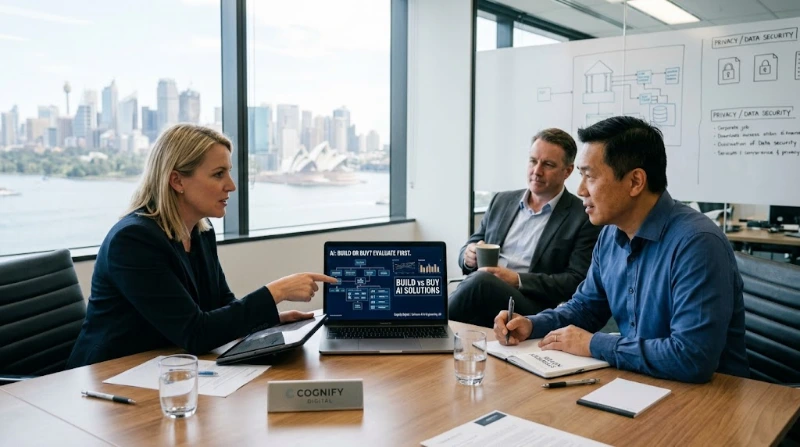
There is also a build-versus-buy decision. An existing model API is often a practical starting point. Custom model development makes sense when a product needs specialised behaviour. Our guide to build vs buy AI solutions covers how to weigh the two.
Fine-tuning is not automatically necessary. Better prompts, retrieval and workflow design often solve the problem without extra training.
5. Design the architecture
Decide how the components fit together: frontend and backend, model integrations, database structure, data retrieval, authentication, cloud infrastructure, security and scalability.
Design for the real requirement. A customer-facing assistant may need fast responses. A background document processor can tolerate longer processing times.
6. Build and validate an AI-powered MVP
A minimum viable product (MVP) delivers the essential functionality first. For an AI document assistant, that might mean accepting uploads, extracting key fields, classifying documents, showing results and letting users correct mistakes.
Test it with realistic documents and actual users. Feedback at this stage exposes problems that internal demonstrations hide.
7. Test, deploy and launch
Test the complete application before launch:
- Functional testing for application behaviour.
- Model evaluation for output quality.
- Security testing for vulnerabilities.
- Performance testing for response times.
- Integration testing for connected systems.
- User acceptance testing for practical usability.
For generative AI, keep a set of realistic test questions with expected results. Re-run it whenever prompts, models, retrieval settings or workflows change. Our software quality assurance team works this way.
Deployment then moves the product into production. Reliable pipelines and hosting matter here, which is where cloud infrastructure and DevOps support helps.
8. Monitor, maintain and improve
Engineering does not end at launch. Real users bring different inputs, and data changes over time. Monitor:
- Output quality and error rates.
- Uptime and response latency.
- API usage and costs.
- User feedback.
- Data and model drift.
A recommendation system, for example, can lose relevance as customer preferences shift. Monitoring catches this before users notice.
A Practical Engineering Decision: RAG or Fine-Tuning?
A common early question is whether to fine-tune a model or use RAG. For a product that must answer from changing business documents, RAG is usually the better first step. The documents can be updated without retraining, and each answer can point back to its source.
Fine-tuning is better suited to a consistent style or specialised task behaviour. In either case, build a test set of real questions first. It turns the choice into a measured comparison instead of an opinion.
Where AI Product Engineering Applies
Each use case needs suitable data, testing and human oversight. These are examples of potential applications, not guarantees of accuracy or suitability.
- Ecommerce and retail: personalised recommendations, shopping assistants and demand forecasting.
- Financial services: fraud detection, risk assessment and customer-facing assistants. Sensitive decisions need controls and human review.
- Enterprise operations: document extraction, intelligent internal search, workflow assistance and predictive reporting.
The strongest use cases solve a clear operational problem. You can see the sectors we work with on our industries page.
Common Challenges in AI Product Engineering
Poor data quality. Incomplete or inconsistent data weakens results. Set up quality checks before relying on AI outputs.
Accuracy and reliability. Models can produce incorrect predictions or unsupported answers. Test difficult inputs and unusual scenarios.
Privacy and security. AI products may handle confidential and personal information. Use access controls, sensible retention policies and secure integrations. If personal information is sent to an overseas model provider, Australian Privacy Principle 8 on cross-border disclosure may apply. The Australian Government also publishes guidance for adopting AI safely.
Integration with existing systems. Legacy software may use different data formats, APIs and authentication. Plan integration early.
Development and operating costs. Costs continue after launch: model usage, cloud resources, storage, monitoring and engineering time. Some eligible development work may qualify for the Research and Development Tax Incentive, so check eligibility with a tax adviser. For a fuller breakdown, read our guide to AI development cost in Australia.
Scalability and maintenance. A system that works for a small test group may struggle under real demand. Plan for capacity, provider outages and model updates from the start.
Best Practices for Successful AI Product Engineering
- Start with a real problem. Define the outcome before choosing technology.
- Validate the use case. Test whether AI offers a meaningful advantage.
- Prioritise data quality. Check accuracy, permissions and availability.
- Choose technology carefully. Avoid unnecessary custom models and complex architecture.
- Build an MVP. Validate core functionality before scaling.
- Test continuously. Evaluate model behaviour alongside application behaviour.
- Protect user information. Apply suitable security and privacy controls.
- Monitor production performance. Track quality, cost and reliability after launch.
Responsible AI also needs clear accountability. The Australian Government's Voluntary AI Safety Standard is a useful reference. For technical guidance, see the NIST AI Risk Management Framework and the OWASP GenAI Security Project.
How to Measure the Success of an AI-Powered Product
A technically impressive model does not automatically make a successful product. Measure against the product's purpose.
| Metric | What it measures |
|---|---|
| Model accuracy | Correctness of predictions or classifications |
| Output quality | Relevance and usefulness of generated responses |
| Response latency | Time taken to return a result |
| Task completion rate | Whether users complete their tasks |
| Adoption rate | How many intended users use the feature |
| System reliability | Availability and failure rates |
| Cost per interaction | Average AI operating cost |
| Business outcomes | Revenue, efficiency or other defined objectives |
An AI support assistant, for example, should not be judged on speed alone. Also assess answer quality, successful resolution and appropriate escalation to a person.
When Should a Business Invest in AI Product Engineering?
It may suit a business that wants to:
- Build a new AI-powered product.
- Add intelligent features to existing software.
- Automate complex information processing.
- Generate predictions from business data.
- Turn an AI prototype into a production application.
Adoption is still at an early stage for most businesses. The ABS reported that around 12% of Australian businesses used AI in 2024-25 (ABS Characteristics of Australian Business), so there is room to build a considered advantage.
However, AI is not always the right choice. If a process follows simple, predictable rules, conventional software or workflow automation may be more practical. Compare business value, development effort, running costs and risk before committing.
Frequently Asked Questions About AI Product Engineering
What is AI product engineering?
AI product engineering is the process of designing, building, testing and maintaining software products that use artificial intelligence. It combines software development, machine learning, data engineering and product management.
How does AI product engineering differ from traditional software engineering?
Traditional software mainly follows predefined rules. AI product engineering also integrates models that learn patterns, generate responses or make predictions, so it needs extra data work and model evaluation.
Can AI be added to existing software?
Yes. AI can be integrated through APIs, machine learning models and retrieval systems. The right approach depends on the existing architecture, available data and product requirements.
What are the biggest challenges?
The most common are poor data quality, unreliable outputs, privacy risk, integration difficulty, unpredictable running costs and ongoing maintenance.
How long does it take to build an AI-powered product?
It depends on scope, data readiness, integrations, security needs and testing. A focused prototype takes far less time than a production application with several integrations. A short technical assessment gives a realistic timeline.
How much does it cost?
There is no universal price. Cost depends on scope, model choice, data preparation, integrations, infrastructure and maintenance. Our AI development cost guide explains what drives the budget.
Conclusion: Building Better Products Through AI Product Engineering
Successful AI products need more than an impressive model or a working prototype. They need reliable data, suitable architecture, secure integrations and continuous testing. Operating cost, user experience and long-term maintenance matter just as much.
The right approach starts with a genuine business problem. From there, teams can validate the use case, choose suitable technology and build something that meets real user needs. For Australian businesses planning a new intelligent product, those early engineering decisions shape long-term success.
Planning an AI-powered product?
Cognify Digital helps businesses turn software and AI ideas into practical digital solutions. Talk to our AI product engineering team or contact us to discuss your project.
Disclaimer: AI technologies, industry practices, government guidance and regulatory requirements change over time and can differ between Australian states, territories and industries. Check the latest official guidance and obtain professional advice for your circumstances.


0 Comments